Add a little variety to your wide format - Print 21 magazine feature
Variable data printing is usually associated with direct mail and transpromo applications but there’s no reason why it can’t be applied to all sorts of digital output—including wide format.
Variable data printing (VDP), one of the benefits of the digital print revolution, proves its worth in production printing every day, particularly in transpromo applications and personalised mail.
Less well-known though is its potential for usage in wide format printing. Well, you might say, who needs it? Who wants variable data printing for a new giant billboard? But wide format printing covers a varied range of uses, many far removed from the huge applications that we see as we speed along the freeway each day.
Neil Westhof, marketing manager, wide format printing systems, for Océ, points to a recent US InfoTrends report that projects increased usage of wide format variable data printing as a productivity tool.
“Variable data printing offers wide format users the opportunity to chase new business without reducing productivity through bottlenecks at the prepress end of the workflow,” he comments. “The great advantage of variable data printing is its ability to versionise a job while printing large quantities.
“It’s simply a matter of adapting RIPs to take advantage of the technology so that large graphics files don’t need to be RIP’d each time you make adjustments to a file.
“It’s great to get a [versioned] job because you have the ability to print small batches of that job with different wording or a different image. However, if it takes time to RIP each batch, your workflow slows and it may cost you money. To make the job pay it must be possible to RIP all batches together so that it flows through as a single job with no prepress bottlenecks
“Current solutions already take into account the ability to work with variable and versioned elements, but these options normally produce individual PDFs for each print. These are then sent to the RIP and onward for processing in the normal way.
Pictured: Steven Badger, Océ product manager for the Océ ColourWave 600 poster printer, with printouts showing a typical VDP example.
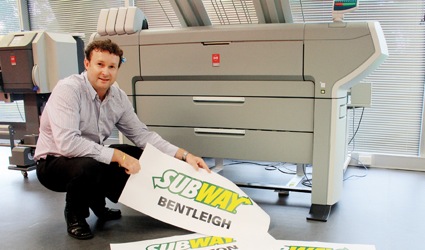
“A new generation of RIPs, such as ONYX ProductionHouse, working in tandem with display graphics printers like the Océ Arizona flatbed range and the ColorWave 600 poster printer, have the ability to handle a job in variable versions in a single RIP. This offers substantial productivity savings for jobs involving VDP.”
Customers get personal
But is VDP currently on the radar for wide format print providers? Increasingly so overseas it seems. The InfoTrends document that Westhof mentions makes the point that print service providers worldwide reported an increasing demand from print buyers for variable data and personalisation.
A parallel report in the Widthwise research by Image Reports magazine in the UK says the ability to add personalisation/customisation to wide format graphics was cited as the most important development to enable wide format printers to compete in the electronic media landscape.
As most printers are aware, variable data printing enables different fields of text and versioned elements, such as graphics and images, to be incorporated into a document without compromising the overall speed of the printing throughput. Although the principle for using variable data remains the same for wide format, its overall effectiveness is tailored more to increasing flexible elements within larger prints without creating delays during the prepress stage rather than the printing.
Says Neil Westhof: “In wide format, the use of VDP differs from typical small-format applications in that the end-application is not specifically aimed at an individual to generate a call-to-action or pay a bill.
“For wide format applications, such as retail advertising, point-of-sale, and general displays, there is a growing need for customised elements to be incorporated as part of an application.
“An obvious case is where you need regional or demographic versioning. Working with a standard background or template, these individual components need to be incorporated as part of the print run without additional operator intervention.
“If you’re doing 500 posters to promote a new hairspray, for example, you might want to put the name of the individual store on each poster, or vary the price point. During an election campaign, you could run off dozens of placards with the same layout but with the name and image of a different candidate on each one.
“In the past, the use of VDP and versioning wasn’t much of an issue because wide format quantities were low and, in any case, were faster and cheaper than the alternative of screen printing or offset. However it has always been a strength of the wide format digital printer that it can produce variations from print to print in a single run, which is impossible using conventional processes. As digital print runs grow longer, it’s time to build on that strength.
“Unlike the screen process, where new screens and origination are required for every element to be changed, digital production enables variants to be incorporated ‘on the fly’ so that speed is maintained.
“Similarly, the growth in wide format print-to-cut workflow has resulted in increases for wider materials to be used for applications that will be finished as labels, stickers, and decals, plus other smaller items for decorative and industrial lots. Automation in this type of workflow includes pre-flighting, batching, nesting, and step-and-repeat, thus encouraging applications where the inclusion of variable data is a valuable asset to the print service provider.
“However, with wide format inkjet production now achieving high throughput rates and longer runs, the need to automate customised elements is becoming increasingly necessary to avoid slowing down the printing process each time a change is made to the file. Average run lengths for a digital wide format application have increased to lengths of several hundred and more.”
Spice up your signs
Westhof says current solutions already take into account the ability to work with variable and versioned elements, but these options normally produce individual PDFs for each print. These are then sent to the RIP and onward for processing in the normal way, incurring time penalties when a large repeat graphic is being used as part of the job.
“RIPs such as ONYX ProductionHouse software give the user one easy workflow that works across different platforms and drives multiple printers from various manufacturers.
“Users can add variable text, images, and barcodes to batch print jobs and preview the results on-screen before spending ink and media. Unlike other variable data tools, the ONYX workflow tool is optimised for large-format printing, so 10 or 1,000 prints start printing almost immediately.
“With solutions such as ONYX ProductionHouse, wide format printers have an additional weapon in their armoury to chase new business, either from other wide format printers without this ability or from traditional offset printers.
“Variety is the spice of life. It should be the spice that attracts new wide format business into your shop.”


