Agfa helps map out your graphic enterprise
The world of printing and the graphic arts is changing at breakneck speed, throwing up challenges that were unimaginable only a few years ago. Through the fog of rapid evolution one entity has emerged to claim a central role in the industry - the graphic enterprise. Garry Muratore charts its origins and rise and predicts how it will change our lives.
Future Vision
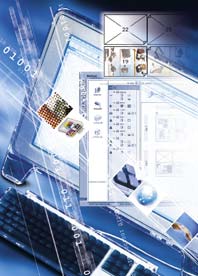 The graphic enterprise represents the culmination of the evolution of print manufacturing - where technology has taken its rightful place to create a flow of data that begins with project creation and ends with its delivery. It is the emergence of print communications. The graphic enterprise is more than a vision; it is an inevitable result of the maturity of technology and the demands of the market.
In the graphic enterprise equipment and processes are not merely linked, rather each component communicates with the other to carry out instructions and provide critical feedback. This type of interactive connectivity extends throughout the enterprise to encompass every step in the workflow - from the first client communication to the delivery of the completed project. It allows various vendor systems to interface effortlessly and perform optimally so that, instead of competing systems presenting stumbling blocks, they work together to shorten turnaround, reduce errors and lower administrative overhead. It connects internal departments such as marketing, purchasing, customer service, estimating and production planning, and external partners such as finishing and transportation companies.
The benefits of such an enterprise are plentiful: faster time to market, lower cost of production, more accurate estimating, more strategic use of personnel, efficient use of capacity, the ability to diversify services with ample room for growth-all of which add up to higher profitability.
No turning back
Whether you believe that technology generates need or need invents technology, the end result is the same - there is no turning back. The graphic enterprise will replace the current manufacturing model as surely as motorways replaced dirt roads. The benefits far outweigh any resistance to change. And there is a solution for all companies that play a role in the production of print; large, small and in-between.
If you believe that technology generates need, then it follows that if we did not have the Internet, for example, we wouldn't need broadband telecommunication networks. However, in reality it is a combination of technological advances and economic demand that shapes the need for change and ultimately generates a paradigm shift.
Over the last few years, more and more printers have found themselves faced with overcapacity. Idle presses force them to cut prices rather than find ways to attract new business. It is the path of least resistance. Unfortunately, cutting prices also eats away at the bottom line.
Printing companies face new competition and need to be agile and flexible with the ability to shift direction and target new markets. This can happen only in the Graphic enterprise.
Clients demand more and more
 Clients today want greater access to more information and they want it at their convenience. Economic pressures transform these requests into demands because brand managers, print buyers and publishers are under extreme pressure to get their projects to market faster, less expensively and with more impact. That means they require higher quality projects completed faster and cheaper.
Clients also want a single source to simplify and reduce their burdens. As a result the printer must move from being job focused to being project capable. In the end, printers must find ways to improve quality, streamline the workflow, and provide new capabilities and lower costs. This is the promise of the graphic enterprise.
The agility and readiness that stems from the graphic enterprise also opens the door to new opportunities. Having to give less attention to production, managers can spend more time nurturing relationships and building new ones. Sales and customer service reps can provide their clients with an array of value-added services. The graphic enterprise repositions print as a critical, time-relevant component of the marketing mix, rather than a commodity.
It is also not the exclusive domain of large, cash-rich organisations. Nor is it designed for a particular type of printing, e.g. commercial vs. packaging. The technology that enables the graphic enterprise can be put into motion to enrich any type or size of workflow. This includes multiple-plant publishing operations, packaging printers/converters and commercial printers, as well small-scale print shops.
The graphic enterprise in action
The most startling difference from the way companies work today is that in the graphic enterprise, production planning takes place very early in the workflow - at the time the customer requests a project estimate. The plan, which describes all resources, processes and actions necessary to produce and deliver the project, is generated automatically. The system is able to do this because it monitors the entire enterprise; it knows which resources are available at any given time. By examining the project requirements, it can generate a plan for delivering the project as specified. And while the plan is completely automated, at any time an authorised user can intervene manually to change it, giving the graphic enterprise absolute flexibility.
PDF-based workflow management software was the first step in the automation of print manufacturing. By transforming document files into streamline digital masters, the PDF (portable document format) revolutionised data transmission. It standardised communication of the content between design and production.
Intelligent workflow management software channeled the PDFs through the various processes giving operators control over the process, yet allowing them to put instructions in motion unattended, using job ticket automation.
Recent advances have made workflow software easier to use, shortening the learning curve and providing greater flexibility. Scalable and modular in design, this new technology provides the building blocks for the graphic enterprise. It enables the print establishment to add functionality as needed.
Agfa's role in the graphic enterprise
 As a founding member of the CIP4 organisation, Agfa is active in the development of JDF standards - a key enabler for the integration of technology and processes across the graphic enterprise.
Agfa's Global Services group provides the expert consultation and technical know how printers need to make their entry into the graphic enterprise. The Delano project management system is a key enabler of this new manufacturing paradigm. It is an interactive window into the entire graphic enterprise. It links the print buyer to the manufacturing process allowing vital client collaboration and elevating the printer's ability to provide relationship-building customer service. Delano also links business and manufacturing processes enabling automated data exchange, and thereby eliminating redundancies, reducing labour and saving costs.
Working in tandem with Delano is ApogeeX, Agfa's powerful prepress production solution. Like Delano, it is JDF-powered for seamless data exchange. It provides users with absolute control of the workflow while enabling unattended automation. Its reliability extends to a “fault-tolerance” fail-safe system that puts a redundant system into play in the event of a power or hardware failure.
Agfa is committed to the continual development of innovative solutions – solutions that will enable the graphic enterprise, giving print providers the means to push-button efficiency and the potential for higher profitability.



 The graphic enterprise represents the culmination of the evolution of print manufacturing - where technology has taken its rightful place to create a flow of data that begins with project creation and ends with its delivery. It is the emergence of print communications. The graphic enterprise is more than a vision; it is an inevitable result of the maturity of technology and the demands of the market.
  Clients today want greater access to more information and they want it at their convenience. Economic pressures transform these requests into demands because brand managers, print buyers and publishers are under extreme pressure to get their projects to market faster, less expensively and with more impact. That means they require higher quality projects completed faster and cheaper.
  As a founding member of the CIP4 organisation, Agfa is active in the development of JDF standards - a key enabler for the integration of technology and processes across the graphic enterprise.