Agfa's :Sublima - magazine quality screening at newspaper speeds
Agfa's :Sublima cross-modulation screening technology has made significant inroads into the commercial print market, with over 1000 installations worldwide.
 Teamed with Agfa's wide range of thermal CTP devices such as the :Avalon family, :Sublima has become the de-facto standard for hi-resolution commercial imaging, greatly surpassing the benefits of second-order stochastic screening systems. With greater ease of use when compared to stochastic systems and superior printability, is little wonder why this technology has found favour worldwide.
Not forgetting newspapers
With violet imaging the preferred technology for newspaper printers due to speed and cost of operation, :Sublima's take-up for newsprint has begun to rapidly grow and Agfa is ensuring its local technical staff are ready to meet the demand, having just held a 10-day training workshop for the entire Australia/New Zealand newspaper CTP support team (pictured below).
 “We can safely say that the entire Oceania team is now as good as any Agfa support team anywhere in the world,” says Koni Neuhofer, newspaper business manager for Agfa.
The training, led by Mireille De Baer - one of Agfa's Belgium-based senior technical support staff - was held at Agfa's Technical Excellence Centre in the Melbourne office in Burwood.
“The focus was to familiarise attendees with the technology, and give them more detailed knowledge, particularly for customising local installations. There were lots of hands-on experiences, and visits to local customers like the Shepparton News who use :Sublima in its daily newspaper production,” says Neuhofer.
Though commercial printing has seen more :Sublima installations than newspaper printing, Neuhofer says this is related to the imaging technology employed in each market segment.
“The :Sublima project was born out of R&D conducted for the newspaper market, so it has been an integral part from the start. Early newspaper CTP engines were green laser and so did not support the screening, which works with violet lasers,” he says.
“With faster uptake of violet plate technology into the commercial segment, :Sublima initially rolled out faster to commercial sites but since the introduction of our violet-based :Polaris and new :Advantage engines, :Sublima is quickly finding a place in newspaper markets.”
How :Sublima works
Using a patented cross-modulation (XM) technique, :Sublima combines the benefits of AM screening (smooth gradations and controllable mid-tones) with those of FM screening (fine detail in shadows and highlights and continuous-tone-like reproduction). It works by aligning FM dots along AM paths and replacing the AM dots at the precise point where the AM dot can no longer be held on a specific press. A smooth transition from one mode to the other is achieved without visible crossover.
By using AM screens in the mid-tones then converting to an FM (but not randomly-distributed) dot placement in the highlights and shadows, a full tonal range can be delivered. :Sublima's XM and FM algorithms deliver 1-99 percent tonal ranges because they place, or leave, fewer dots of an optimised and minimally-defined dot. Line screenings of 180lpi on standard newspaper stock are attainable and the use of high line screen frequencies also eliminates costly subject moire.
The technology also accounts for press characteristics so it will not produce a dot that cannot be held on the press. Enlarging or reducing images does not affect quality or the ability to sustain details and a variety of papers can be used at high line rulings, providing the same level of print quality on high-gloss coated stocks, translucent vellums, and newsprint.
 Tints, solids, and type simulating spot colours can be created using only CMYK - eliminating the need for customised colours or switching inks on the press.
Rather than change the pressroom to match the screening requirements, :Sublima matches the screening to the pressroom by accounting for typically-used paper types, printing architecture, and other variables like typical ink tack, blanket release and so forth. It works within the established parameters and uses the smallest optimised and printable dot for the application.
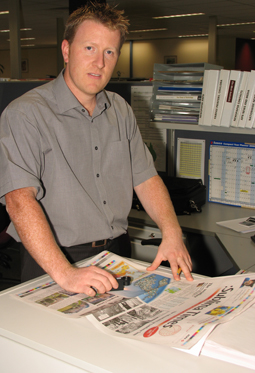
“Instead of asking what screen ruling should be used, the more important question is what is the minimum dot size that can be printed easily,” says Steve Marshall, Agfa (pictured right), who attended the region-wide training.
“Higher line rulings create a greater risk of losing highlight details on the press and printing mottled or posterised effects, so it is important to determine the smallest-sized dot that can be held on the press,” he says.
Newspaper printing with :Sublima
According to Marshall, newsprint's substrate defines the screening parameters for newspaper printing, not the quality of the imaging device, plates, or ink.
“Newspaper printing works with much lower resolutions, for processing speeds, so the minimum dot size of the engine is larger, between 35 and 40 microns, whereas it's about 28 microns for commercial printing,” he explains.
“Using conventional screening, newspapers would normally work with 100lpi or, at best, up to 133lpi. To increase this resolution with conventional screening you would need to reduce the dot size, which would result in reduced image quality,” he says.
“However, because of :Sublima's cross-modulation technology, newspaper printers can attain 180lpi without having to reduce the dot size or lose image quality, and to achieve 180lpi on newsprint is a quantum leap in quality.”
Agfa's :Sublima screening works with a printer's current press and workflow configurations and, as it handles in the same way on the press as conventional 100lpi screening, there are no added costs from extra staffing or lengthy training needs. It also negates the need for older technology like square-spot imaging systems. It can be used in all newspaper production environments and is currently available with all Agfa :PolarisX and :Advantage CTP systems.
About Agfa
The Agfa-Gevaert Group is one of the world's leading imaging companies. Agfa develops, manufactures and markets analogue and digital systems for the graphics industry, healthcare sector, and specific industrial applications. Agfa's headquarters are in Mortsel, Belgium. The company is active in 40 countries and has agents throughout the world. It achieved a turnover of 3,308 million euros in 2005 (approx. A$5,606 million).
Agfa Graphics offers integrated prepress solutions (comprising consumables, hardware, software, and services for production workflow, project and color management) to the printing industry. Computer-to-film, computer-to-plate and digital proofing systems have earned Agfa Graphics a worldwide leadership position in the commercial and package printing and newspaper publishing markets, and it is rapidly expanding its offerings in the growing digital inkjet market.
Product and company information can be found at www.agfa.com.


 Teamed with Agfa's wide range of thermal CTP devices such as the :Avalon family, :Sublima has become the de-facto standard for hi-resolution commercial imaging, greatly surpassing the benefits of second-order stochastic screening systems. With greater ease of use when compared to stochastic systems and superior printability, is little wonder why this technology has found favour worldwide.
 “We can safely say that the entire Oceania team is now as good as any Agfa support team anywhere in the world,” says Koni Neuhofer, newspaper business manager for Agfa.
  Tints, solids, and type simulating spot colours can be created using only CMYK - eliminating the need for customised colours or switching inks on the press.