


------
The tingling sensation in my ears was telling me the air temperature on a bleak hill just outside of Lincoln was around two degrees C. This was nothing compared to the numbing cold experienced by the tail-gunner in a Lancaster hurtling through the dead of night somewhere over Germany - when the outside temperature would hit minus 20 degrees C. Locked in a flying tomb for up to nine hours and scanning the deep void for enemy aircraft, even your own urine would freeze solid and the chocolate biscuits so kindly provided by the young WAAF orderly would turn to blocks of concrete. But at least I didn't have Germans firing ack-ack guns at me when I took my place on this windswept hill overlooking Lincoln, along with several thousand others, to help celebrate Bomber Command's role during the last war. Bomber Command has occupied a somewhat ambivalent position in Britain's psyche over the past 60-odd years, as it has drifted in and out of favour, depending on which way the winds of political correctness were blowing. By its nature, it conducted its operations in a clandestine manner - taking-off in the dead of night, out of sight/out of mind of ordinary Brits. By contrast, Spitfire pilots conducted their operations in full view of an adoring public, in broad daylight - and almost overhead if you lived in Kent! Never the less, the 'bomber boys' managed to win 19 Victoria Crosses for their efforts. But none of this seemed to count, as accusations of indiscriminate bombing, of killing civilians and of taking resources away from other wartime priorities were easy to make and difficult to refute. The then leader of Bomber Command, 'Bomber' Harris probably didn't help, with his single-minded, obsessive preoccupation with obliterating non-military, as well as military targets. He master-minded the attack on Cologne in March '42 involving 1,042 aircraft as a show of strength and to demonstrate to the likes of Churchill, and other sceptics, that Bomber Command could deliver a deadly blow from the heavens above. This raid may be seen as a metaphor, or template, for the role of Bomber Command generally: the raid was a great success, but, delivered at enormous cost (in this case, 41 aircraft). By war's end, however, the overall cost was that almost half of all aircrew would be either: killed in action, injured or taken prisoner, and the average age at time of death would be a staggering 23 years of age! This pattern - dramatic success versus a horrific mortality rate - was to dog Bomber Command for the rest of the war. Sadly its 'successes' were always going to be tinged with the spectre of civilian casualties. Whether they were innocent civilians or actually part of the German war effort would be one of those imponderables which always left Bomber Command vulnerable to attack. Us humans can't, or don't want to, differentiate between over-zealous or bad decisions made by military leaders, and the men who have to bravely 'do their duty'. And we should remember, the 1940s was still very much the era of the white picket-fence and of unswerving duty to King and country: servicemen did not query or challenge orders, they just did what they had to do. Dresden didn't help the PR story either, even though its detractors easily forget that the German attack on civilian Coventry was probably the catalyst for that ghastly game of tit-for-tat. But that was the whole point behind the creation of this international centre, high on a hill overlooking Lincoln. Not to create yet another static museum - in fact it has very few 'exhibits'. Set on 10 acres, it is essentially a research centre and a digital archive, bringing together stories of airmen from the 62 countries who participated in Bomber Command during the war - and to record in one place forever, the names of nearly 58,000 ... those who never returned. There are several peace gardens reflecting the native flora from all five continents - but at heart, its role is in bringing about reconciliation: ironically, not only with the enemy, but with the British public, who for over 60 years have wanted some form of acceptance of Bomber Command's role, but who have been thwarted by timorous British politicians who have kowtowed to the bleeding-heart minority. This, sadly, is a familiar refrain, as Australia's own Minister for Veterans' Affairs had to be shamed into providing government funds to send our 17 remaining Bomber Command veterans to this very symbolic ceremony. It seems to be a failing of democracy these days, just how out of touch our politicians are with their electors. But I also noted there was not one member of the Royal Family in attendance. Were they all so busy attending cocktail parties that none of them, not even a distant cousin or relative, could show up? I took it as a snub that not one member of the royal household could attend an event which goes so deeply to the heart of the British nation. But as the Centre itself states: Reconciliation implies that those who were once divided by conflict are prepared to put the past behind them and co-exist ... It is also about acknowledging that not everything done by the winners of the war was just or right. Reconciliation is not about triumphalism ... it is about our common humanity [and hopefully will encourage debate] about the bombing war which, all these decades on, is capable of arousing strong emotion. That, I think, is a pretty frank and fair admission that we, as humans, don't always do everything right, and that such brutal honesty is a pretty good starting point for reconciliation. I think Australia's very own Vietnam vets, who were coerced into going in the first place and who got short shrift from a government upon their return, could relate to these sentiments. Ironically, as a side note: during the ceremony, no mention was made of ‘Bomber’ Harris who is still considered a divisive figure - the Centre's main building is named the Chadwick Centre after the designer of the iconic Lancaster bomber - reminding us that some things are still a bit too raw. Over 10,000 Aussies participated in Bomber Command's war effort and they were all volunteers. I was here, on this windswept hill, to represent my late father, Wal Cryer, DFC, a bomber pilot himself - before returning to run the family printing business in Sydney - and to accompany a sprightly nonagenarian, Tony Adams, who was my father's wireless operator (WOP) on their many sorties over Germany. They, and the rest of their crew, were among the lucky ones. And lady luck was at her best, or worst, during those sorties. Tony recalls an incident flying at tree-top level over France while attempting to drop badly needed supplies to the French underground resistance movement. With only visual navigation to guide them on this moonlit night, they were rapidly approaching the drop-zone deep in the forest when his radio cut out. Frantically whacking it (in a technical manner, of course) it refused to cooperate until a few minutes - probably seconds - later, it spluttered back into life only to tell them: "Return to base! Return to base!" The Germans had intercepted the hide-out and instead of a welcoming committee of grateful French citizens there would have been a hail of bullets from the Oerlikon sub-machine guns lurking in the forest clearing. Why had that radio suddenly burst back into life? Was it destiny? Was fate? Was it kismet? - or just a faulty valve having fun? Who knows, but these are the sort of imponderables that war leaves trailing in its wake. My father (who hardly ever spoke about the war) used to remark that during these flights over France, they flew at such frighteningly low levels that the vibrations from their Rolls-Royce Merlin engines would probably smash all the windows and crockery of the very citizens they were trying to help! ...... The Centre itself is a giant experiment, as it's possibly the first in the world to adopt the ‘reconciliation and research’ approach as opposed to just being another war museum. It is to its eternal credit that it and hundreds of volunteers have persevered for over nine years - often against daunting odds and a lack of political support - and have demonstrated a vision not shared by politicians. But even though Lincoln's bitter cold tried to do what the Germans couldn't, Tony was here, larger than life - a sprightly 94-year old enjoying his new career as a media tart, having been interviewed by multiple outlets including the BBC evening news and Australia's Channel 7. The following day he was going to give a talk to the ladies auxiliary at Methwold, a tiny village in Norfolk, where he and my father's crew were stationed during the war. I said to Tony, if he plays his cards right, he could even get a mention in Print21! There are now only a few hundred vets still alive and kicking around the world, but the Centre is keen to collect stories from anyone who has any association with Bomber Command during those dark days. I know we Aussies love to bag the Brits (and they richly deserve it), but to their their great credit they have done an outstanding job - with little thanks to the government - in creating this on-going testament to the ordinary, everyday men and women who put their lives on the line for us. If you have a relative who contributed to Bomber Command - who you know of someone who did, get onto the website, they'd love to hear from you. Visit www.internationalbcc.co.uk - or even better, visit Lincoln and see it for yourself. Tony Adams featured in a BBC report about the International Bomber Command memorial:-
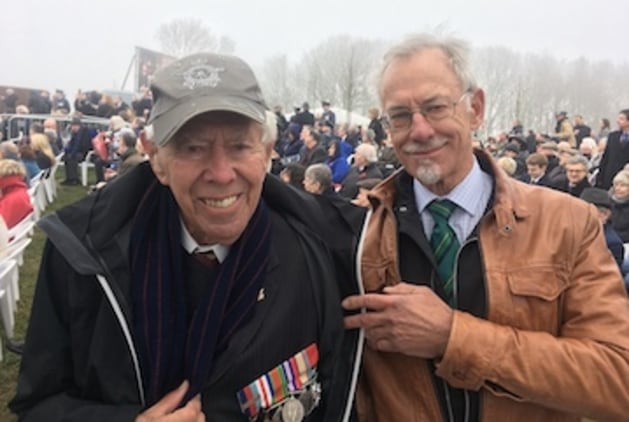
 James Cryer Tony Adams
 -
 James Cryer (r) with wireless operator Tony Adams, 94, at the opening of the International Bomber Command memorial.
 -
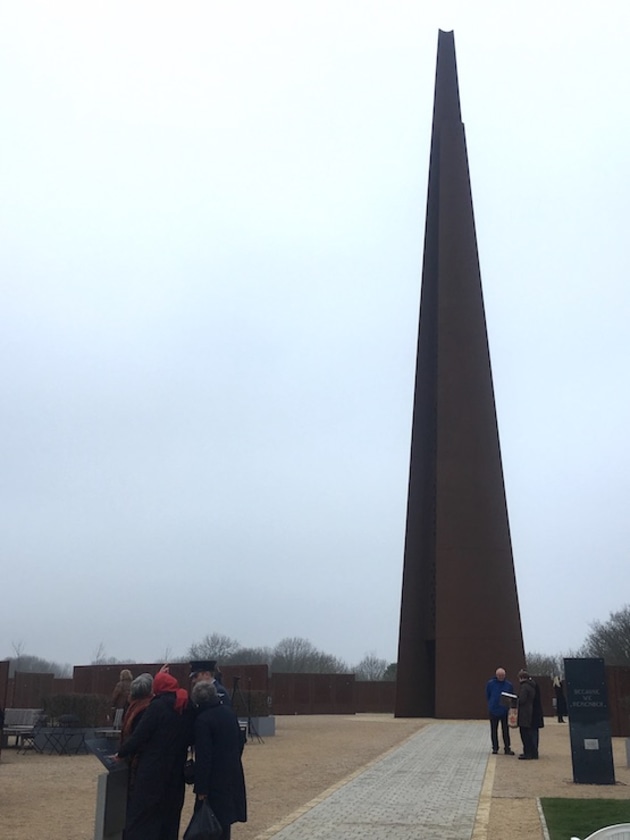
 The Spire, part of the newly-opened Bomber Command Centre in Lincoln. Able to be seen for miles around, like a welcoming beacon at a wartime aerodrome, it is 31m in height - the same length as a Lancaster's wingspan.
 -
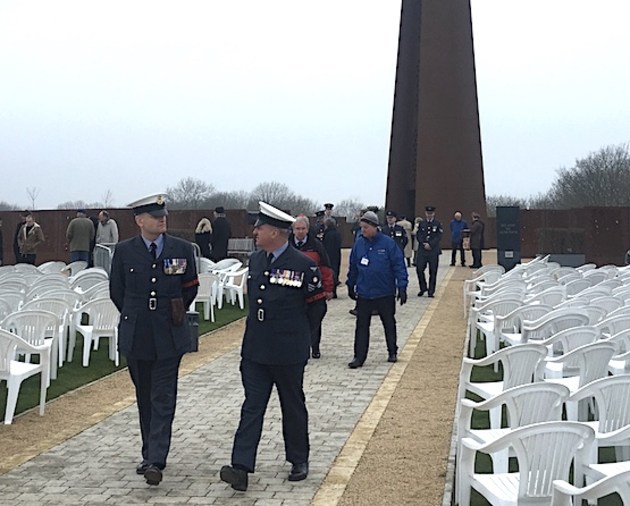
 The newly-opened Bomber Command Centre in Lincoln.
 -
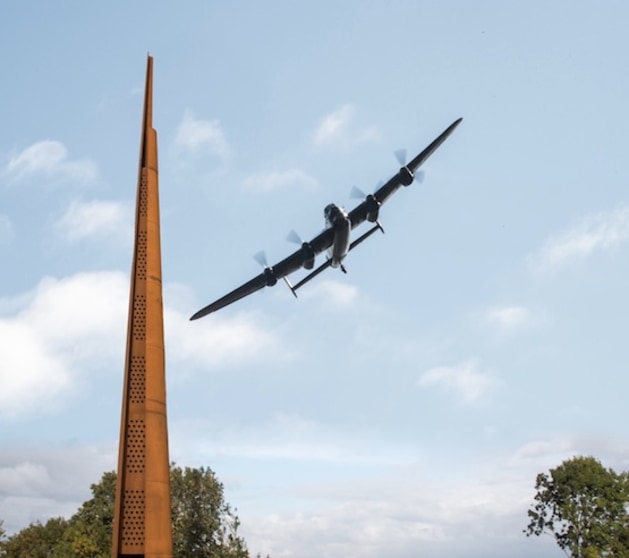
 bcc photo 555
Australians who flew for Bomber Command honoured in UK
Britain has acknowledged the role Australian personnel played in Bomber Command during the last war. On a windswept hill in Lincolnshire, there now stands a memorial and research centre that houses a massive database containing the personal stories of the brave airmen and women, who fought for the defence of freedom.
A contingent of 17 Australian veterans who served in Bomber Command were flown over by the Australian Government for the opening ceremony. Printing industry identity, James Cryer, was invited to attend to honour his father, Sydney printer, Walter 'Wal' Cryer, who piloted Lancasters during the war.