Black day as press giant sees red – Print21 magazine feature
It’s not the way anybody in the industry wanted 2011 to end. Although a shock, the news that press giant manroland filed for insolvency can hardly have come as a great surprise to anybody who has pondered the future of offset press manufacturing in recent times. While the final outcome is still uncertain, Simon Enticknap looks at the immediate aftermath of a black day for the industry.
In the US, the day after Thanksgiving Day is known as Black Friday. Rather like our Boxing Day madness, it is the day when department stores around the nation open their doors early and are inundated by hordes of shoppers in search of a bargain. It’s called Black Friday because of the congestion it causes as millions of shoppers literally fight each other in their desperation to get the best deal. They take their shopping seriously in America.
This year though, Black Friday had rather more ominous overtones for the printing industry as it was on this day that the German press giant, manroland, announced that it was seeking insolvency protection. For industry observers who have long speculated about the continued survival of three large German offset press manufacturers in the current environment, it seemed like the day of reckoning was finally upon us.
The decision by manroland to instigate insolvency proceedings was prompted after negotiations with a potential backer fell through and the existing owners (75 per cent Allianz Capital Partners, 23 per cent MAN) refused to inject any more capital into the business. In a last-ditch attempt to retrieve the situation, the manroland board also applied for ‘self-administration’ so that it could complete its restructuring program. In the event, the proceedings are said to be the second largest corporate insolvency case in Germany in recent times.
Rivers of blood
According to reports in the German newspaper, Frankfurter Allgemeiner Zeitung Allianz invested more than €1 billion in manroland in 2006, and then injected a further €200 million two years ago. In the meantime though, despite shedding jobs and launching new ‘non-printing’ engineering services, manroland has struggled to adjust to changed market conditions. Even operating at 60-75 per cent of pre-GFC levels was insufficient to stop the flow of red ink.
Of course, there have been plenty of other offset press manufacturers go out of business over the years on both the sheet and web sides of the industry. Iconic names in the quick print sector such as Hamada, AB Dick and Itek have fallen by the wayside as digital print has taken hold. Most recently, well-known Japanese press manufacturer, Shinohara, filed for bankruptcy in the wake of an ill-timed attempt to consolidate its manufacturing sites and liquidate valuable real estate. There was a feeling then that if a well established, family-owned Japanese offset press manufacturing company could go to the wall, for whatever reason, then the canary was well and truly gasping in the mineshaft.
With manroland though, the fact that it has found itself in dire straits is even more significant, and symbolic, for the industry. As a company, it has deep roots in the culture of industrial print dating back to mid-19th century. Its name is synonymous with many of the major developments in the history of offset printing. This year, for instance, the company celebrated the centenary of the ROLAND, the world’s first rotary sheetfed offset press that made its debut at the World Fair in Turin in 1911.
Maybe somewhere, at some point, someone has calculated how many trillions of pages, publications and packages have been produced on manroland equipment over the years; whatever the figure, there’s no doubting that the print created on manroland machines has touched the lives of billions of people over the course of the past 150 years. That’s an impressive legacy, in anybody’s terms.
Anybody lucky enough to visit the company’s vast manufacturing plants in Germany, as I have on a couple of occasions, can attest to the sense of history that almost seeps up out of the floor, the heritage of German 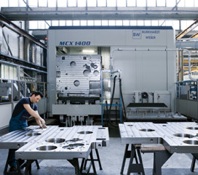 engineering passed down from one generation to the next that is practically irreplaceable. Of course, the Black Friday announcement doesn’t automatically signal the end of this tradition, but it must give pause to even the most sanguine supporters of offset print and raise serious questions as to where its future lies.
Rays of hope in a false dawn
I was last in Germany at manroland in Offenbach in May this year for the sheetfed summit, which attracted customers and media from around the world. It was an impressive event, held in lieu of the fact that manroland did not show any press equipment at the previous year’s Ipex, a sensible decision in many ways. Some of the print samples I saw at the summit were outstanding, perhaps the best I’ve seen, especially given there was no post-press finishing being done. Everything was done inline, at great speed and with absolute precision.
Not long afterwards, the company announced that it was ending short-time work arrangements at the plant, which had been in place for nearly three years. Things seemed to be looking up.
“Putting an end to short-time work sets a clear signal that we are moving ahead. Our internal measures have proven to be effective; coupled with a strong market performance, this allows us to embrace the opportunities that lie ahead with much greater optimism,” said Dr. Markus Rall, the head of the sheetfed division at the time.
As recently as September, the company was talking up a 13 per cent increase in incoming orders for the first half of 2011 and was predicting total sales for the year of more than €1 billion.
Such optimism proved to be short-lived however. In the notice announcing the company’s decision to file for insolvency, it states that it was triggered by another dramatic downturn in incoming orders, which can be noticed since mid-July and has recently accelerated. Furthermore, it says, the market is now operating at only 50 per cent of its pre-GFC size with the US and Europe particularly badly hit. Even China has been hit although business there remains brisk.
This downturn had an impact on the entire industry, the force of which was not foreseeable, said the statement.
Well, maybe. Of course, nobody can predict with certainty when a particular market is going to drop off the cliff and, certainly, the economic conditions currently prevailing in Europe are unprecedented. It is equally true, though, that commentators and analysts have been suggesting for some considerable time that maintaining three German offset press manufacturing companies in a market where the share of offset print is declining is not a sustainable long-term option. Many felt that it was only a matter of time before something like this had to happen; the market can be defied for only so long.
A couple of years ago, there were reports of manroland and fellow German manufacturer, Heidelberg, looking at the possibility of a merger at the urging of manroland’s majority owner, Allianz. Nothing came to fruition however. In the end, the entrenched vested interests in maintaining the status quo proved to be too obdurate to overcome; some-times the weight of history can be a millstone, not a platform.
Long and winding road
So where to now? No doubt the ‘proceedings’ still have a long way to run and the final outcome, at the time of writing, is far from clear. For the time being, manroland is emphasising that it is ‘business as usual’; the statement issued states that: The executive board of manroland aims to rescue key units within the framework of ongoing restructuring efforts as debtor in possession. The initiated insolvency procedure affords the opportunity to step up the restructuring process and guide the company through this difficult phase. The process, it says, offers plenty of prospects.
Again, it has been pointed out that manroland is not the first big press manufacturer to find itself in such difficulties; Goss, for instance, filed for Chapter 11 protection in 1999 before sailing into smoother waters and eventually finding a home with the Shanghai Electric Group. Given the current state of the financial markets, however, it’s hard to see where the white knight is going to appear from in this instance; in Europe, there is simply no money for investing, and certainly not in heavy metal engineering.
If it is true though that every cloud has a silver lining, then German rivals KBA and Heidelberg are certainly feeling the benefit at the moment, given that their share prices lifted by up to 15 per cent immediately in the aftermath of the announcement. Such a response, however, is a knee-jerk reaction. While both KBA and Heidelberg may experience some increase in sales resulting from 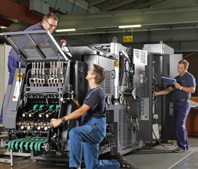 manroland’s difficulties and subsequent restructure, the fact is this is an industry in the throes of a major realignment, one that has seen print volumes plummet and a shift to alternative technologies. Any short-term gain will only serve to mask the long-term pain.
Even if manroland were to exit the market—and nobody is predicting that with any certainty at the moment—even having only two big German offset press manufacturers might still be too many.
Locally, there is a certain irony about the news of the insolvency proceedings given the recent announcements of orders for two 96-page heatset presses at the country’s two biggest printers, PMP and IPMG. Together with the new Lithoman press installed recently at Franklin Web in Melbourne, the prospects for manroland in Australia looked rosy indeed, in the heatset web market at least. When I spoke to Steve Dunwell, manroland Australasia MD, recently he indicated there were other projects in the pipeline too; 2012 was promising to be an exciting year for lovers of big, fast thundering presses.
The question must be raised whether such customers will now be prepared to stump up progress payments to a company that is insolvent? In these matters cash flow is king and you would need very firm assurances before you continued with payment.
In the sheetfed sector, while not having the same market penetration as Heidelberg, manroland nevertheless has some power users locally, such as Colorpak and Hannapak in packaging, and Lithocraft and Vistaprint in commercial print. These businesses have built their operations around the proven durability and performance of manroland’s press technology, so the prospect of any potential restructure involving an exit from the sheetfed market is sure to be of concern.
Since taking on the task of running the standalone manroland presence in the region, Dunwell and his team have worked hard to re-establish the old Roland brand and build up the service and consumables side of the business. It would be tragic to see all those efforts go to waste. Certainly everybody involved with the company, customers and staff alike, will be hoping that Black Friday will indeed turn out to be the darkest hour before the dawn.


 engineering passed down from one generation to the next that is practically irreplaceable. Of course, the Black Friday announcement doesn’t automatically signal the end of this tradition, but it must give pause to even the most sanguine supporters of offset print and raise serious questions as to where its future lies.
 manroland’s difficulties and subsequent restructure, the fact is this is an industry in the throes of a major realignment, one that has seen print volumes plummet and a shift to alternative technologies. Any short-term gain will only serve to mask the long-term pain.