breaches the Great Wall of China
The threat of cheap Chinese print remains one of the biggest points of debate in the industry, but according to the group of Australian printers who just returned from a reconnaissance tour to the country, the Australian print market is not a major target for the Chinese printing industry. Robert Fuller, national operations manager for Printing Industries, says Australia is still considered a relatively small and emerging market given the large volumes that they already process for the USA, Europe, and Canada.
“There is no doubt about China's printing industry capacity to achieve its goal of becoming a world print centre. Chinese owners and managers that we spoke to have a perception dominated by a 'can do' approach to business,” says Fuller.
 “They are totally customer service focused, tend to look outwards, and are always seeking joint ventures and partnering opportunities with overseas business that can add value - especially management and Western style systems that will assist their business to compliment the low wage cost advantage that they readily acknowledge,” he says.
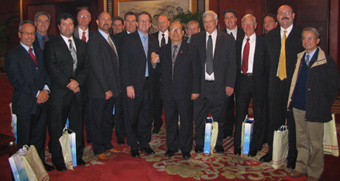
(Above: Robert Fuller, centre, with Mr Wu Wengxiang, director of Printing Technology Association of China, Australian contingent members and Shen Zhong Kang, far right, senior engineer, Print Technology Association of China)
Fuller said the perception that China's printing industry is overstaffed, pushing sweat-shop labour practices and lacking in basic international workplace standards was not at all evident on the tour. Instead, many of the print factories visited by the Aussie printers were ISO 14001 party accredited and held a number of other certifications.
“In many cases these may have been required by end user overseas customers,” says Fuller. “But nevertheless, these print firms have responded to that market imperative. They are now beginning to focus their attention on improving environmental initiatives.”
Whilst there remain a significant number of full or partially state-owned print businesses, Printing Industries claims those that are privately owned display a highly entrepreneurial culture that embraces business opportunities whenever identified. And while there are business opportunities for Australian companies, there are also some difficulties.
“A significant impediment remains transport logistics,” says Fuller. “These dictate that a minimum of four to six weeks is required from sign-off to delivery in Australia - however this can quickly extend up to eight weeks if the job has to wait for a container to fill. Also quotations, firm price negotiations, and contracts remain heavily entrenched in the culture of relationships unlike the Australian method of conducting business.”
The tour covered the full breadth of printing facilities in China and Hong Kong including sheet-fed plants, web, digital, bindery, packaging, and related manufacturing plants. A key element of the tour was not just the inspections of plants and operations, but also in-depth discussions on business dealings with Chinese firms to offer delegates practical guidance and answers to the pressing questions of 'how to do business with China.'
“One thing now certain is that those Australian representatives who went on the tour have absolutely the best first hand information on how to do business with China if they decide to go down this path,” says Fuller.
The importance of the Printing Industries' leadership of this delegation was driven home with a full and frank diplomatic discussion between the Australian delegation and Yu Yongxhan, the Chinese minister for printing, publications and communications. Fuller claims this set the scene for an 'open door' policy of meetings with senior Government representatives, association presidents and technical experts in each region.
Talking to the big boys
To ensure delegates obtained a comprehensive understanding of the Chinese print industry, high level discussions and inspections included printing machinery manufacturing plants, the Gold East Paper Company (one of the world's largest paper suppliers) and the Print Technology training facility.
“At one of China's largest print operations situated on the banks of the Pearl River Delta region that we inspected, 18,000 workers lived in very modern company condominiums, supported by company owned and operated facilities including: a fire-brigade with three fire-engines (including snorkel truck); ambulances; internet café (100 computers); night club; restaurants; post office; bank . . . and its own formal printing industry dedicated training school,” says Fuller.


 “They are totally customer service focused, tend to look outwards, and are always seeking joint ventures and partnering opportunities with overseas business that can add value - especially management and Western style systems that will assist their business to compliment the low wage cost advantage that they readily acknowledge,” he says.