Clancy . . . overflow . . . the best bits . . . funnies
It’s the kind of opening remark attendees at the Creo Users Association (CUA) Conference in Florida, 18 - 21 May are likely to hear. By then the Kodak takeover of Creo should be complete and in addition to being addressed by Langley, the Creo users will also have an opportunity to tackle Jeff Jacobson, who will be the chief operating officer of the Graphic Communications Group. Jacobson, along with Creo president Judi Hess, and Creo CEO Amos Michelson, have all volunteered to take part in the ‘bull pen,’ a traditional highlight of the conference, where users get to ask the really tough questions.
Such as . . . “Will Creo survive as a brand name under Kodak?”
–––––––––––––––––––––––––––––––
End-to-end workflow is all about getting enough suppliers up to speed to promote the interchange of functions between different brands. While the Creo-backed NGP is having success fast forwarding a select group of like-minded manufacturers (now over 40) as a subset of the protocols, the original CIP4 group is trying to match the outreach of the Canadians. The US-Based Association for Suppliers of Printing, Publishing and Converting Technologies (NPES) is hosting a JDF Developers Tutorial under the auspices of the Swiss-based organization, similar to the successful event held in January at Heidelberg, Germany. The aim is to help companies that wish to develop their own JDF applications catch-up with the CIP4 members who already have introduced JDF-enabled products to the market.
Although NGP maintains it is not in opposition to CIP4, the rivalry between the two is proving to be intense.
–––––––––––––––––––––––––––––––
Australian packaging firm Amcor is set to make a heap of dough (sorry) in the UK after winning a multi-million dollar contract to produce around 15 million bread bags a week for national baker, British Bakeries. On the strength of making so much bread (sorry) the company is extending its plant in Ledbury, Worcestershire to accommodate 4,500 palettes of the bread bags.
Let’s hope the deal earns a better crust (sorry) for Amcor than for previous incumbent, Parkside Performance Films in Barnsley, which crumbled (sorry) into bankruptcy last year.
–––––––––––––––––––––––––––––––
They say a personal commendation is the best form of advertising, and Quark is advertising lots of personal commendations about its new English-language free technical support. It’s all part of the new user-friendly face of Quark following years of treating its customers with disdain. Now that Adobe InDesign is posing a real threat to its once unassailable hegemony in layout programs, Quark is bending over backwards to make up its lost reputation.
One user happy to lend his support is Ian Ainslie, of FlyLife Publishing, Australia. He wrote: "To be honest, my initial reaction after ringing the number and finding I was speaking to someone in India was surprise and apprehension. However, I soon began to have complete confidence in the support person I was talking to as I began to realize his tremendous depth of knowledge of the Quark program and the operating system I was using.
“The purpose of this e-mail is firstly to thank you for the technical support and secondly to give praise to the professionalism of the person I was talking with. He was very interested in solving my problem, obviously highly skilled, and possessed excellent communication skills."
–––––––––––––––––––––––––––––––
If you sometime bemoan falling prices and rising costs in printing consider the cardboard box industry where, according to Visy Industries’ CEO, Harry Debney, box prices today are less than they were ten years ago (even in straight dollar terms, not adjusted for inflation). In an interview with Pulp & Paper Edge www.industryedge.com.au he said the 5.8 per cent average increase in box prices over the past five years is insignificant compared to increases in waste paper prices (20 per cent in only two years), distribution costs per tonne (12 per cent in three years), and wage increases (4.75 per cent per annum).
According to Debney, Visy has been able to minimize price increases by increasing productivity assisted by capital investment.
–––––––––––––––––––––––––––––––
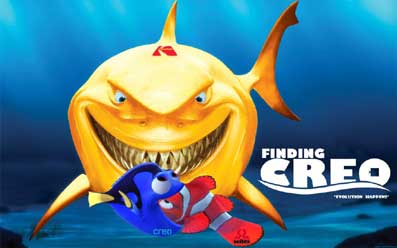
And finally . . . here’s a telling visual sent to Clancy by Steve Dunwell, NSW Manager of the Currie Group and one-time Creo employee.
With apologies to Jonathan Swift;
So, naturalists observe, a fish
has larger fish that on him prey;
and these have larger still to bite ’em;
and so proceed ad infinitum.
(Yes,little the red fish is Scitex)