DIC opens doors of secure ink plant for LIA tour
LIA members explored the ink manufacturer’s Auburn site last night in a behind-the-scenes tour, covering production of its export business.
Stepping from room to room, four tour groups were guided through plant operation by DIC staff to examine ink production from raw materials to lab R&D, mixing and distribution. The manufacturer exports around 60% of the plant’s total colour production to Asia Pacific.
Each group got a chance to see how the company produces its array of heatset, coldest, solvent flexo and solvent-based gravure inks. It even makes buckets of ink for overseas newspaper printing.
According to Ian Johns, managing director of DIC Australia, the Auburn plant currently exports around 600 tonnes of ink a month to Asia Pacific.
“We have been growing in South East Asia for newspaper inks for some time now. The ink we make in Australia is already sold in China and is now being exported to Japan, a market strongly focused on quality.
“With around 230 sites around the world, DIC is now a US$10 billion global company. Over half of that is the DIC graphics business for inks, and the rest is the trading arm dealing with chemicals,’ he says.
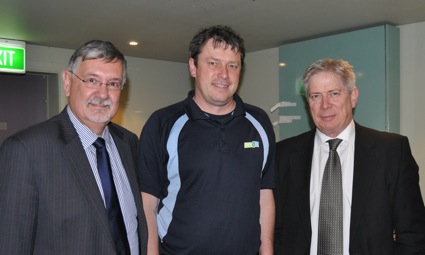
Pictured: LIA NSW president David Wells (left) with DIC’s technical services manager for web Stephen Packham and Ian Johns, managing director.
The Auburn site is currently commissioning a new bulk white ink manufacturing plant to support the flexo and gravure industry, which DIC hopes to have up and running before Christmas.
David Wells, president of LIA NSW, says there was a strong turnout for the event that encouraged a younger crowd to explore the inner workings of the industry.
“Each tour had their own DIC guide and technical people to explain the technology involved in making the ink, preparation for export market, to the zoning of manufacturing for particular colours.
“As an association we are delighted that closed doors to other parts of the industry are open to us, because we represent the industry and technical experience of our members. They in turn come out to these functions to learn, see, and better understand their industry,” he says.


