Digital printing with Currie - what you sow is what you gain
What you see is what you get became the mantra of computing, once GUIs (graphical user interfaces) gained popularity. Pioneering digital printers Michael Tann and Albert Tedja used the term to name their company WYSIWG (pronounced wiz-ee-wig), in the nineties.
Changing every rule they could and then inventing some new ones, only to find ways of breaking them; they were the first in Asia-Pacific to install the digital star of IPEX 1993, the Indigo E-Print 1000. A dozen years on and they are on their third Indigo digital press - the stunning HP Indigo 5000 - and business is great. Which goes to prove, what you sow is what you gain.
Pioneers of digital print - the early years
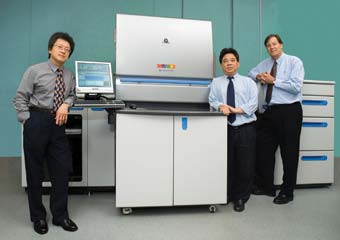 In 1994 Michael Tann and Albert Tedja of Sydney-based PostScript Bureau WYSIWYG dipped a toe into the digital print water. By hooking up their own Fiery Rip to a Canon CLC laser printer they offered short run digital print at an output of eight A4 colour pages per minute.
(The winning team... From left, Michael Tan and Albert Tedja with Steve Dunwell, Currie Group NSW manager)
However, this tenacious company saw demand, and then opportunity for more sophisticated digital print. Converting that vision to reality required insight and persistence for the successful PostScript Bureau. Seeing what was then available in larger markets like the US, principals Tann and Tedja identified Indigo and the E-Print 1000 as the machine that could open up digital print down under.
However Australia was considered a small market, but after some time and what Tann describes as an amount of convincing, Indigo and WYSIWYG introduced the first E-Print machine to the Asia-Pacific region.
Steep learning curve
By October 1994 WYSIWYG was the proud owner of two E-Print 1000s. “It was a steep learning curve,” said Tedja. “We had weekly meetings with Indigo engineers and then ink supplier Toyo.” Tann, Tedja and the Indigo team constantly tested, refined, tested, recalibrated, and refined the process until they were happy with the results.
What they now had was the ability to print two thousand colour pages per hour on each E-Print 1000. But, much more, WYSIWYG was able to offer for the first time short run digital print of offset standards.
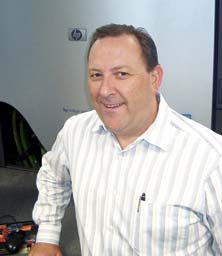 “WYSIWYG was then, as it is today, a pioneer in digital print,” according to Phillip Rennell, Business Business Manager of HP/Indigo supplier The Currie Group (pictured right). “They operated the first digital ink on paper machines, capable of running from a print run of one; with a short-run print quality then unheard of in Australia,” he says.
WYSIWYG's next task was to educate the market, which again Tann and Tedja recall was a demanding job. They told everyone who would listen about the new process and found graphic designers, predictably, the first to embrace the process.
Business starts to flow
“No print run too short;” - words that were music to the ears of Sydney designers in the mid '90s, and business soon flowed in to keep the E-print 1000s busy. Producing a true press proof for one client, while starting a 300-run for another client minutes later might be commonplace today, but twelve years ago it was revolutionary.
Tann recalls a milestone when in 1995 WYSIWYG entered work from the Eprint 1000 into the 'Offset' category of the Australian Print Awards. There was no digital print category then. WYSIWYG raised a considerable number of eyebrows by claiming Bronze.
Serious digital print had arrived in Australia.
Still one digital step ahead
Through the late nineties the digital market started to mature, though early adopters found introducing and operating short run digital print a steep learning curve, more E-Print 1000s appeared around the country.
Tann recalls while Indigo - since taken over by HP - continued to upgrade the E-Print 1000s, boosting productivity and quality, they had their eye on the next great machine. Constantly researching the much larger digital print market, WYSIWYG installed one of the country's first HP Indigo 5000s in February 2006.
Still digital print pioneers, Tann and Tedja call the new 5000; “a quantam leap forward” in digital print technology. The new press runs at double the speed of the E-Print 1000 with an impressive output of four thousand pages per hour.
The quality is arguably the highest for digital print in the country, and the HP Indigo 5000 has taken liquid ink technology to a new level. Six-colour Indichrome printing (CMYK, Orange and Violet), vastly expands digital printing's colour gamut. “Customers notice great colour vibrancy,” says Tedja. “The print quality has been favourably compared to offset six-colour Hexachrome.”
The HP Indigo 5000 yields up to 225lpi screen ruling, which is finer than most traditional offset printing.
Another technological leap forward much appreciated by WYSIWYG and its customers is the ability to print on several substrates in one print run. While Indigo has always been able to run a wide variety of substrates, the new Indichrome ink technology means faster, higher quality jobs, turned out easier.
“For example we can save time on printing for, say a manual, by printing a full colour cover, tab pages and mono text pages all on different stocks in the same run,” says Tann.
Zero make-readies on the run
In fact with the HP Indigo 5000, operators can load one paper tray while printing from another paper tray, effectively allowing them to set up a proof for one client while running a completely separate job for another: - completely unheard of in offset print.
With digital print technology, the market has matured. Today's short run customers are educated in digital print. They know they can save vast amounts of money by printing only what they need to offset quality, but cost is not the only factor. “Customers want high quality results immediately,” says Tann.
He elaborates. “A job came in at 4:00 pm yesterday afternoon, three kinds of business cards with a print run of 50 each. It had to be in Bondi Junction by 10:30 this morning. We delivered it a bit early, I think.”
Tann recaps, “If the client wants to see a proof there's no guessing involved, they can see a true press proof immediately. What customers have seen they can get - and therefore increasingly want - is on demand print, an extremely flexible service and very high quality. What you see is what you get.”


 In 1994 Michael Tann and Albert Tedja of Sydney-based PostScript Bureau WYSIWYG dipped a toe into the digital print water. By hooking up their own Fiery Rip to a Canon CLC laser printer they offered short run digital print at an output of eight A4 colour pages per minute.
 “WYSIWYG was then, as it is today, a pioneer in digital print,” according to Phillip Rennell, Business Business Manager of HP/Indigo supplier The Currie Group (pictured right). “They operated the first digital ink on paper machines, capable of running from a print run of one; with a short-run print quality then unheard of in Australia,” he says.