Don’t judge Australian books by their covers - Print21 magazine feature
The book publishing sector is one of the most heavily automated sectors within our industry, and it needs to be. Manufacturers rising to the challenge of eBooks have increased efficiency throughout production lines to keep physical books relevant in the digital age. Changes in workflow and technology have enabled Australian publishers to hold their own with offshore competitors. Cameron Boggs flies in for the scoop.
Walking through Griffin Press’s plant in Adelaide it is readily apparent that automation is king in the world of book production. As the first journalist to see the world’s first HP T350 high-speed inkjet press and Müller Martini SigmaLine configuration in action, I witnessed the inline transformation of paper to books.
As one of the largest and longest-established book printers in the country, this division of PMP produces around 25 million books a year. Increased efficiency in labour and technology, back-end and front, has enabled the publisher to meet growing demand for shorter run work. Continuing its trend of automating the plant to efficiently produce as much volume as it can with as little labour as possible, the HP/Sigma bind line adds short-run digital print to the mix.
The installation of the new line has shored up Griffin Press’s production capability into three tiers, positioned between its Xerox book factory and three custom-built Timson offset book presses. This workflow structure allows the publisher to optimise print runs, taking full advantage of all three lines.
Even as one Timson press sits silent due to seasonal requirements, Griffin’s plant is now capable of printing anything from a single book to over a million copies with even greater efficiency than in years past.
According to Ben Jolly, general manager at Griffin Press, the biggest challenge the business faces is cover production. While a Komori sheetfed press handles conventional covers and a Ricoh C900 takes care of the HP/SigmaLine, the entire onsite process needs to be accomplished in the shortest amount of time possible to get the book out the back door.
“What happens in the conventional process is that while we’re printing the cover we’re also printing the text, and the two meet up in the bindery. Whereas in the HP workflow, we’ve got to get the cover to the press before we start printing the text. Logistically it’s just a little bit different to what we are traditionally used to, and so there is a lot of transitioning going on,” he says.
The manufacturer has re-engineered itself over the past decade towards a greater relevance in the Australian market, so that it can compete with the emergence of eBooks. In many instances, Griffin Press has been the first to install various pieces of automation throughout its plant.
“Being the first means that we’re learning along the way, rather than having expertise around us to help us. That creates day-to-day challenges in terms of learning something on the fly.
“All new equipment comes with its own challenges in terms of learning how to operate, and get reliability out of them. The mere fact that all those investments we’ve made in being the first in this country or first in the world have been successful, is a testament to some of the people that we have here,” says Jolly (pictured).
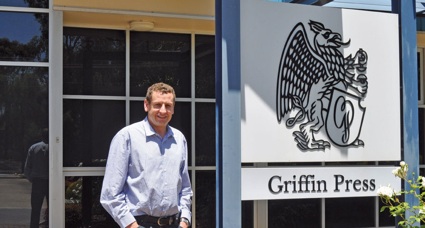
He explains that the primary reason behind Griffin’s push for automation is to improve the viability and sustainability of the business, whereby making processes faster and more reliable. Automating production also helps the company look after the health and wellbeing of its staff working in the factory.
On its path of ongoing investment, Jolly envisages the company will continue to invest in new technology so long as there are the volumes there to support the outlay. Though it has no plans to go full colour with the HP inkjet at this time, it’s certainly not something it has ruled out.
“The framework and infrastructure of the HP line can be upgraded to colour. Would we do that? Time will tell,” he adds.
The open floor plan of the plant gives the ability to restructure its production lines as it sees fit when new technology comes into play. A new Müller Martini Corona binder is due late February to take over the workload of its two format-driven Timson presses. While the plant’s bindery capacity today far exceeds its press capacity by design, Jolly believes the new binder will deliver greater labour efficiency and produce work faster.
“Work off both presses will go on one binder. Because the new bindery has a higher level of automation, it means we can change formats far easier than what we can today. We will be retiring one of our older binders, and keeping the other one as contingency as the new binder takes on the majority of the work.
“The bindery is notoriously the bottleneck of all the places you go to within the printing industry. The greater speed of output will make sure it’s not so here,” he says.
Apart from the covers, the entire book manufacturing process of the HP/SigmaLine in Griffin Press has been taken over by the machine. So much so that a press operator standing on a centralised control system can monitor the whole print run through to folding, collating and binding.
Massive shift to automate
The industry shift to replace skilled labour with automated electronics is a massive trend introduced by industry suppliers, according to Livio Barbagallo, managing director of Müller Martini Australia.
“With the technology available nowadays to equipment suppliers, a lot of functions that were traditionally done by an operator are now done by electronics.
“That’s what we can see with our latest development for the Australian market, the SigmaLine. For that you need IT and process knowledge, rather than the traditional bindery operator skill set,”
he says.
As the current market trends towards smaller equipment due to shrinking circulations, Barbagallo feels that automated equipment’s true value is in its ability to quickly changeover from one job to the next.
Kathy Wilson, general manager of business solutions and production at Ricoh Australia, believes the most significant impact of automation is in the opportunity for businesses to redeploy staff in areas where they can add a lot more value.
Automation’s biggest challenge, she says, is in making sure bad processes are not automated. Its biggest advantage is cutting down errors. Waste reduction and staff redeployment are key value areas in book production, especially when inline finishing is an integral part of the manufacturing process. Wilson feels that with challenging economic times people need to have a good handle on the costs in their business before turning to automation.
“Once they become really aware of the costs associated with the process or the product that they’re selling, then they have the opportunity to look at areas of increasing their efficiency.
“If you automate a process, you have the opportunity to have less hands touching and the less human intervention, there is the less variation and opportunities for manual errors. I think automation equates to efficiency and cutting down on waste,” says Wilson.
No small fish
At the end of the day, the manufacturing process behind book production is a complicated endeavour even when simplified as much as possible and embellishments are left out, says Michael Schulz, director of SOS Print & Media Group.
With a combined annual turnover of $40 million, Sydney-based SOS is no small fish in the game of print. Yet when compared to Griffin’s large-scale output, Schulz’s company produces a comfortable 40,000 books per month in digital production.
“Distinct pricing pressures and the demand for fast, very short-run and POD production make it paramount to constantly improve and rationalise  production. Manual processes increase wage costs and extend delivery times.
“Automation is key and the more processes can be brought inline, the less manual labour is involved. But at the same time, inline is not always the most productive or flexible solution. At SOS we pursue a more modular approach, which allows us to combine best in class equipment from different manufacturers,” he says.
Schulz has seen the increased drive towards shorter runs and POD within short timeframes due to competition from overseas and from other media.
“Print on-demand especially is changing the supply chain,” he notes. “Being able to produce books in runs of one within 24 hours and shipping them to consumers is becoming more common. It is changing the way books are sold and distributed—as opposed to distributed and then sold.”
He believes that automation of production and administration is imperative within a print house, especially as the dedicated book printers in South Australia and Victoria begin to migrate volume from their offset presses to digital.
Keeping the book-publishing sector relevant to the market is crucial to its very survival; manufacturers are ever searching for new technology to help them compete with eBooks. Automation is king within the printing industry, especially in book production where its speed to market defines profitability.


 production. Manual processes increase wage costs and extend delivery times.