Donaldson helps Salmat make the chop
Newly installed waste handling recycling loop sees millions of paper off-cuts recycled each week at Salmat’s Moorebank production site.
Salmat called in Donaldson to configure and install a system to collect all paper edged trimmings, which are then passed on to paper and cardboard recycler, Visy.
Donaldson’s chief engineer, Dominique Ollitrault, said that the main objectives for the paper waste disposal system were to improve the waste management system, preventive maintenance and meet EPA requirements.
“With a high-volume of outsourced billing going through the processes at Salmat, the company is trimming about 1,000,000 pages per week and needed a reliable solution to not just collect the waste but also a way to effectively redistribute it at the end point,” he said.
Ollitrault chose to design a system that extracts and separates paper trim waste with a separator instead of a cyclone.
“The principle behind the separator operation, as opposed to a cyclone, is that an inclined baffle plate, situated within an expansion chamber, knocks the product out of the air stream rather than relying on a cyclone’s geometry to cut a specific portion of product by centrifuge and internal vortex,” he said.
“The advantages are compactness, flexibility and low energy consumption.”
The system extracts paper trim and dust from various trimming machines on the Salmat processing line. Each machine has its own chopper fan to chop up continuous paper trims to reduce the risk of blockage through the main ductwork system.
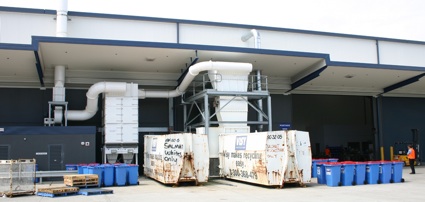
In the loop: Salmat saves money and paper with its new recylcing system. 
All the chopper fans are connected to a common trim-handling fan and ductwork. The product coming from the chopper fans, ductwork and main trim fan is then transported to the separator where strip is separated and returned via a chute into the compactor.
Air and dust is then transported through the dust collector where the dust is separated from the airstream and an air emission of < 15 mg/m3 can be expected.
Two 110-litre bins underneath the dust collector collect the dust. The main system, which comprises a trim fan, separator, and rotary valve, is mounted onto a common platform and is located outside. The dust collector and clean air fan are installed on the floor next to the compactor.
“An important aspect of the design of a waste handling system is to make sure that conservative materials handling principles are followed to ensure various problems do not occur,” Ollitrault said.