Double DPX century for Currie CtP
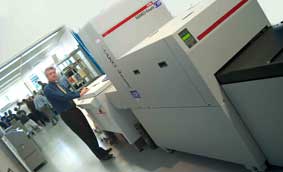
 Easily the highest-selling CtP machine in Australia, the DPX polyester plate system has recently passed the 200 installed mark. Currie Group’s director, Bernie Robinson (pictured) has had something to do with every one of them. Print21 journalist, Colleen Bate, caught up with him to talk about DPX’s domination of the A3 CTP market.
Back in the 90s, positive predictions on the future of polyester plate technology may have been met with some cynicism. Yet now it is a feather in Bernie Robinson’s cap to have focused on its merits so early in the piece.
“At the time, AM International was selling what they called photo-direct type plate makers, which would take a hard copy, reflect it into a mirror, and the mirror would then transfer it back onto the piece of polyester plate and you would get an image of it,” he said. “Desktop Publishing had just entered the market, and we marvelled at the fact that you could combine type on an Apple Mac with a 600 dpi printer and produce the same quality as traditional typesetting. With the demise of imagesetters on the cards, it was time to pursue a CtP product and the only product we felt was acceptable to our market was the DPX.”
The Danish company Purup Eskofot, had the product at the time, Bernie had a good relationship with the company and the rest is history.
200 up and rising
Initially, DPX met with resistance in the industry. Robinson admits; “For many years we had to convince our prospective customers that they could produce full-colour process printing using polyester plates. They all said: ‘You can’t do that! It’s not metal! It won’t last.”
Today, the Currie Group has 200 DPX polyester CTPs in the field and a further 70 or so metal CTP units. “I would say that all those 200 units have at one stage produced 4-colour process work.”
A printer cited to have installed one of the earlier systems in Australia, is Brisbane-based Bayfield Printing. Bayfield’s Tom Hayward enters the Queensland Print Awards annually and consistently wins gold medals for quality—a case in point for polyester.
Numerous well-known printers would not dream of being without DPX systems in their print shops. The likes of Melbourne-based Blueprint, BGS Printing and Flash Print, Brisbane’s All Clear and Smithton newspaper, the Circular Head Chronicle, all bear testament to this. Single-width newspapers also love the DPX’s productivity and performance.
Evolution of DPX
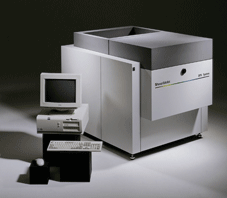 Surprisingly, the DPX has evolved with relatively minor enhancements for over a decade.The only major change to speak of came in ownership—Esko Graphics merged with the Belgian company Barco, to become Esko and in April 2006 was acquired by US company, ECRM, along with its assets and intellectual property of the polyester plate equipment business.
Robinson believes the technology has remained the same with only, “a bit of refinement here and there.” The system’s full daylight operation, internal vacuum drum system and built-in open punch have remained unchanged. Minor internal changes, such as a smaller development tank, were introduced at drupa 2000. New owners ECRM are expected to unveil a revamped version soon.
“It has maintained the same engine, the same laser, the same internal drum,” he says, pointing out that although the DPX was new technology 10 years, it is considered new technology even today.
“It is still the only CTP on the market that allows you to hold a job in a queue and produce 100 plates, stacked up, dry and ready to go. It is producing something like 37 plates an hour, so is very highly productive for the A3 printer. The preference for any printer would be to use a piece of metal to go on the press. The reality for the owner is that it is cheaper to load a polyester plate and invest under $90,000 on a DPX CtP, that he knows will have a lifespan of at least five years,” he adds.
Pre-loved DPXs in demand
Refurbished DPX platesetters are widely sought out in the industry, and sold before they traded-in. “Generally, Currie Group has a lot of refurbished systems coming in. After eight years, printers are planning to replace their systems. So the old machines are being traded in. We are stripping the old machines, refurbishing them and putting them back out at the lower end of the market to feed two-colour Fuji-Shinoharas or two-colour GTOs with CtP plates.
"As it’s a $50,000 investment, CTP becomes an affordable option,” says Robinson.
Currie’s Melbourne facilities include a full workshop with machine refurbishing facilities for traded-in equipment. This serves as Currie’s national refurbishing centre for all of its branches.


 Easily the highest-selling CtP machine in Australia, the DPX polyester plate system has recently passed the 200 installed mark. Currie Group’s director, Bernie Robinson (pictured) has had something to do with every one of them. Print21 journalist, Colleen Bate, caught up with him to talk about DPX’s domination of the A3 CTP market.
 Surprisingly, the DPX has evolved with relatively minor enhancements for over a decade.The only major change to speak of came in ownership—Esko Graphics merged with the Belgian company Barco, to become Esko and in April 2006 was acquired by US company, ECRM, along with its assets and intellectual property of the polyester plate equipment business.