


drupa press round-up - LIA and GASAA events a success
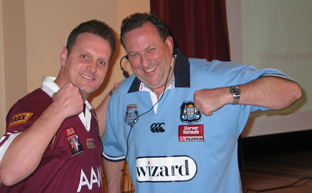 'State of Origin' rivalry was played up by friendly rivals and digital printing presenters Brett Maishman, Fuji Xerox (left) and Phillip Rennell, Currie & Company at the second post-drupa night in Sydney.
The first event last week focused on prepress and JDF, which was the theme of the trade show, while keynote speaker Scot Telfer focused the second meeting on the presses, the heavy metal, of drupa. He opened his address by describing his response to JDF as that of a fan going to a Black Sabbath concert and discovering Burt Bacharach was performing.
(Your correspondent was in Melbourne for the prepress night at which Garry Muratore of Agfa took centre stage. According to organiser Warwick Roden, the speakers were energised, informative and dynamic. General consensus of those that were there is that the night was a great success.)
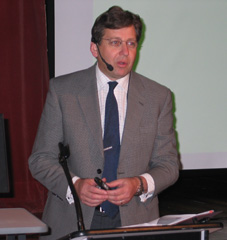 Scot Telfer's (pictured) comprehensive survey of the presses at drupa revealed that despite the turmoil of the industry over the past decade the press manufacturing sector has remained remarkable stable. Of the press names missing after ten years he only nominated Miller and Planeta.
He described this drupa as a show at which there was nothing radically new, no technology breakthroughs, comparing it to recent shows which saw the debut of such technologies as CTP (1995) and digital printing (2000). This time he speculated whether direct imaging presses were going to be the future of the industry, and surprisingly for an offset aficionado, he picked the Kodak Versamark inkjet press as the “complete standout” of the show.
As befits one who was responsible for bringing the first Heidelberg 10 and 12-colour presses into the country at Websdales, Telfer’s ‘alphabetical’ tour of the press complement at drupa was informed and insightful. Among his other observations he pointed out that:
 'State of Origin' rivalry was played up by friendly rivals and digital printing presenters Brett Maishman, Fuji Xerox (left) and Phillip Rennell, Currie & Company at the second post-drupa night in Sydney.
 Scot Telfer's (pictured) comprehensive survey of the presses at drupa revealed that despite the turmoil of the industry over the past decade the press manufacturing sector has remained remarkable stable. Of the press names missing after ten years he only nominated Miller and Planeta.
Scott round off his survey with some expert observations on the development of feedboards, pointing out that some press makes were still using the same technology from 30 years ago, while others, notably KBA and Heidelberg had cleaned up the vital function making it operator friendly. The same was true for feeders with some presses still “full of spaghetti” with tubes going everywhere while others had simplified the controls.
His in-depth presentation was warmly received and much appreciated by the audience. He had obviously taken considerable pains to put together his review and made attendance at the LIA/GASAA event well worthwhile.
ANZPAC, digital presses and Andy McCourt
 The jam-packed programme on the night continued with Bob Mercier (right) and Carlos Schwinidt of ANZPAC sharing with their experiences in upgrading the folding carton manufacturer’s press and die-cutting equipment. It proved to be an informative and revealing presentation on the process that led to Mercier and his team deciding on a 40 metre KBA Rapida 142 to replace an aging Lithrone 650.
It shows what happens when the budget is sufficient for pressmen to go out and examine the technology on it own basis, not confined by price. It’s not a situation many enjoy.
 Carlos (left) made a valiant effort to fire the audience with his own enthusiasm for the technical advancements of die-cutting. This fairly esoteric presentation lacked nothing in the way of commitment from Carlos, but this writer was more impressed by the presenter’s obvious knowledge than by any of the details. Suffice to say die-cutting speeds have doubled in 30 years.
The night continued with a rematch of Phillip Rennell of Currie & Company with HP Indigo, and Brett Maishman of Fuji Xerox, professional rivals but firm friends presenting their companies’ different digital printing technologies. Making a play on the State of Origin on the night they appeared in Queensland and NSW jerseys. While the Maroons may have won the football on the night the two presenters played a draw.
 Andy McCourt (pictured right)wrapped up the night with a suggestion that the audience should imagine how the industry would look in 2010. He nominated environmental concerns and the industry’s “social contract” as the two main areas of importance.
Print Month Australia, a nation-wide event, to promote the positive aspects of the industry to the wider community was announced for August 2005 and he urged all present to get behind it.
The LIA/GASAA nights over two weeks prove that the Sydney industry will turnout when the content of the presentations make it worthwhile. All concerned, especially Grant Churchill, president of the NSW LIA, Warwick Roden, and Angus Scott, national president LIA, should be congratulated as well as Gary Knespal of GASAA and Jim Hopwood, the new state manager of Printing Industries