Face Exposure - How new technologies are expanding the capabilities of photopolymer platemaking?
Creo is a leader in the development of screening technology. While its well-known Staccato screening is widely used in commercial printing, it also has screening technologies for use with other imaging processes.
In today's competitive business environment, there is tremendous pressure to continually improve the level of quality that is obtainable when using digital or conventional photopolymer plates.
Recent enhancements in screening technologies are helping to take flexography to the next level in quality standards. Let's take a closer look at two new technologies from Creo.
The Challenge
One major limitation in the flexographic printing process is the inability to properly form all of the dots in the highlight ranges on plate and on press. To work around this limitation using AM screens, minimum dot sizes and or bump curves are applied to the digital file, which usually results in very noticeable transitions from inked to non-inked areas.
Historically, this has been accepted “as good as it gets" or has forced the increase or addition of colour in the highlight ranges to prevent the image from having a carved up look, as demonstrated in the examples below.
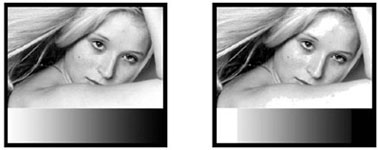
Target Image (left) and Typical Flexo Result (right)
One solution to these challenges is to use a Hybrid AM screening technology, which increases the size of the dots in the highlight ranges without sacrificing image integrity by increasing or adding colour. The end result is a reduction or elimination of the noticeable transition from inked to non-inked areas.
Hybrid AM algorithms avoid the use of microdots by defining a minimum dot size and by using FM screening techniques below the problematic threshold such that tonality is controlled by varying the number of dots (FM), rather than the size of the dots (AM).
The following graphics demonstrate the concepts behind Hybrid AM screening technologies. In Figure 1, the graphics represent the typical results seen with flexography; the tonal range becomes compressed and a very noticeable transition area between the inked and non-inked areas in the highlight range forms.
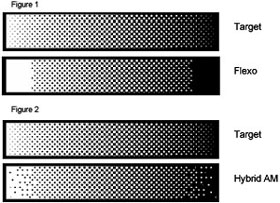
Figure 2
In Figure 2, by using a Hybrid AM screen, you are able to increase the smallest dot on the plate while randomly removing dots to prevent any unwanted addition of color in the highlight ranges.
Hybrid AM screening is not a new concept. However, historically, it has not been the panacea it was hoped to be due to a lack of integrity in the smoothness of the screen, generating visibly grainy and structured highlights. This lack of integrity or uniformity of the screen is due to the fact that the highlight “FM” dots are constrained to fit onto the AM grid and the result is not as smooth as a true FM screening technology. There are several Hybrid AM screening engines available on the market, but they are not all created equally. Although the basic concept is the same in each case, the smoothness of the screen is dependent upon how the screening engine builds the screen in the highlight areas.
Creo has studied the relative advantages and disadvantages of different Hybrid AM algorithms and has determined that a more homogeneous rendering is achieved using a mixture of dot sizes, effectively smoothing out the non-uniformities in the highlights and transition areas. In addition, these same screening concepts can be applied to the shadows to aid in minimizing any noticeable transition from a screened area to a solid area. Traditional Hybrid AM screens use a fixed dot size in the FM portion of the highlights; this leaves holes in the AM grid that yield non-uniformities and patterns in the rendering.
The application of a Hybrid AM screen in a flexographic computer-to-plate (CTP) workflow can effectively eliminate the need to apply bump curves, while still minimizing dot gain through the advantage of dot sharpening, which is inherent in digital plates
Further improvements in quality can be found by using object- or element-based assignment tools, which allow you to apply these Hybrid AM screens where best applicable and not force a global application to the entire design.
Another new technology, which is complementary to Hybrid AM screening, is a concept developed by Creo referred to as “HyperFlex”.
The Next Challenge
When exposing a photopolymer plate with an AM screen, dots that are placed in a uniform fashion support each other during their formation on plate with an effect commonly referred to as "bridging". However, when we utilize alternative screening methods like Hybrid AM screening, the number of dots is reduced in the highlight ranges and, therefore, we reduce the overall support provided by the remaining dots. This increases the overall pressure on each dot and impacts the rendering capabilities of the dot in processing and printing.
HyperFlex is a new technology from Creo that aids in the formation of small dots or graphic elements on a photopolymer plate. The following images will help to convey the enhancements to the platemaking process that can be gained when using HyperFlex.
In Figure 3, we have tried to push the limits of the platemaking process and hold 25-micron dots in a 1% tone at 120 lpi. As you can see, the dots are not well-formed on plate and there is a significant risk that the results on press will be less than desired.
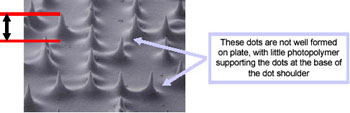
Figure 3
In Figure 4, we have applied the HyperFlex technology to the dots in the highlight ranges only. The HypreFlex process helps to reduce the relief depth in between dots and expands the base of the shoulder so the dots are better formed, which allows you to hold a smaller dot than you normally would be able to with current technologies. An additional benefit is that the surface area of the dot remains the same, so the HyperFlex process does not add any unwanted dot gain on press.
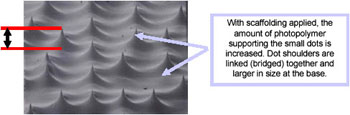
Figure 4
Figure 5 below shows a cross section through a plate with a typical Hybrid AM screen. Notice that in the highlights all of the dots are the same size but some are isolated and unsupported. These isolated dots will not perform well on press.
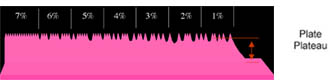
Figure 5
In contrast, Figure 6 shows the same plate with HyperFlex applied. The result is less relief in the highlight areas, providing more support to the isolated dots and superior performance on press.
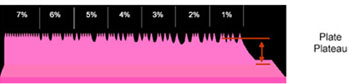
Figure 6
In conclusion, new digital technologies continue to expand the capabilities of photopolymer platemaking. Improving Hybrid AM screens and the combination of Hybrid AM screens with HyperFlex are examples of how applying science to flexography will continue to improve the competitive position of flexo relative to other technologies.
Creo offers a Hybrid AM screening solution called MaxTone™. MaxTone and HyperFlex are part of the Prinergy Powerpack™ workflow management solution. Prinergy Powerpack is the core of an all-digital system for packaging trade shops and converters. It is a flexible, automated, end-to-end native PDF workflow management solution with an integrated Oracle® database to track job status and history, manage archiving, and generate detailed production reports. Its client/server architecture facilitates job collaboration and resource sharing, and makes Powerpack scalable for expansion to fully automated, high-volume production.
Creo Launched New Sleeve-Imaging Flexo CTP and New Prepress Technologies for Packaging and Converting
Creo has launched the next generation ThermoFlex® imaging device with sleeve imaging at CMM International along with demonstrations of Creo’s other new prepress solutions for packaging printers, converters and trade shops at CMM, McCormick Place in Chicago, IL, April 14-17.
Versatile and Flexible
The first of the new ThermoFlex devices is being installed this month. It images variable repeat sleeves, yet retains the ability to image digital flexographic and rotary letterpress plates, and film with formats up to 52 x 80 in. (1321 x 2032 mm). This design provides flexibility for trade shops and converters that run digital plates, digital plates-on-sleeves and continuous sleeves, depending on the requirements of a specific customer or job.
The new ThermoFlex includes semi-automatic changeover from plate imaging to sleeve imaging and accommodates sleeves with repeats up to 42 in. (1050 mm) and lengths up to 72 in. (1829 mm) in both continuous digital photopolymer sleeve and digital plate-on-sleeve formats. Sleeve-imaging productivity—regardless of repeat size—matches or exceeds current plate-imaging specifications, providing the fastest sleeve-imaging capability available.
Sheet-to-sleeve-mode turnaround is greatly aided by storing the sheet-imaging drum on the ThermoFlex. In less than three minutes, the drum can be decoupled and safely stored without using heavy lifting equipment. This minimizes capital expenditures and space requirements, allowing even small trade shops and converters to benefit from this new technology.
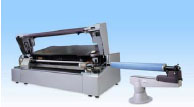
Creo features the new sleeve-imaging ThermoFlex CTP device for flexographic printers.
Enhanced Productivity
The ThermoFlex device significantly improves the productivity of today’s plate-on-sleeve workflows. It also produces sleeves with staggered seams or lanes to a level not previously seen. A built-in sleeve load/unload system minimizes sleeve handling and potential damage to the sleeve’s digital mask and substantially reduces the time required and difficulty associated with changing from one sleeve to the next. The complete sleeve system from Creo also includes a production hub that facilitates sleeve handling between the ThermoFlex and auxiliary equipment, including the plate-mounting and UV-exposure steps required in a sleeve workflow.
New Flexo Screening Technologies
For high-quality flexographic printing, Creo offers MaxTone™ screening, a hybrid AM screening solution that overcomes highlight and shadow reproduction limitations. MaxTone uses high-quality Prinergy® AM screening through the main part of the tone scale. Highlight and shadow tonality is managed with larger dots that are more printable, and tonality is controlled by varying the number of dots using sophisticated FM screening techniques. MaxTone allows users to specify different dot sizes in highlights and shadows, independent of screen ruling, angle and dot shape. MaxTone is available in version 2.1 of the Prinergy Powerpack™ workflow.
A brand-new technology from Creo, called ‘HyperFlex’, complements MaxTone. It aids in the exposure of small dots or graphic elements on a photopolymer plate. HyperFlex helps to reduce the relief depth in between dots and expands the base of the shoulder so the dots are better formed and ready to stand up to the wear and tear of normal use. HyperFlex preserves the size of the dot and the intended tonality, but makes it possible for printers to work with smaller highlight dots. Users configure MaxTone and HyperFlex to suit the behavior and leverage the capabilities of their manufacturing operation.
End-to-end Packaging Solutions
Prinergy Powerpack is a PDF-based integrated and automated workflow management system designed for packaging converters and trade shops. Based on the Prinergy workflow and using industry standards such as Adobe® Extreme®, PDF, PJTF, JDF and Oracle®, Prinergy Powerpack creates a predictable and reliable manufacturing environment that automates steps, reduces errors and streamlines operations. Specific features for flexography include a unique layout-scaling feature (raster scaling), which maintains the dot structure on the substrate, as specified in the workflow.
New Trapper Available
The Creo PDF Trapper features enhanced functionality and user-friendliness in addition to the existing automated and manual, press-ready PDF-to-PDF vector trapping and interactive editing. The new technology replaces the existing trapping of the Prinergy and Prinergy Powerpack workflows. Enhancements include:
- Better usability through an improved user interface in the Trap Editor plug-in;
- Incorporated separation viewer functionality;
- The ability to automatically set black bitmaps to overprint;
- The ability to automatically trap all colorized bitmaps correctly;
- Easier trapping of double hits of spot color (no more playing with neutral density values);
- The ability to automatically overprint black strokes less than a specific width;
- The ability to set keepaway traps.
Packaging Workflow for Brisque Users
The Brisque® Pack workflow, ideal for operators already familiar with the Brisque workflow, is a CT/LW packaging solution that offers step-and-repeat options, drives proofing and plate-imaging devices, and includes specialized flexo screening and distortion capabilities. Creo is showing Brisque Packwith the ThermoFlex Narrow CTP device, which was developed and priced to meet the needs of the tag-and-label and narrow-web market.
New Features in Pandora 2.0
The latest version of the Pandora® step-and-repeat application includes many new features for flexographic converters and trade shops. Pandora 2.0 now supports JDF, the industry-standard for exchanging data and processing instructions within a workflow process. This makes integrating Pandora into existing workflows, even easier than before. Other new features include:
- Editable non-rectangular bleed paths automatically derived from CAD die line information;
- Bleed overlap detection with advanced, easy-to-use tools for automatic overlap correction;
- Die-station ordering with fully automated placement of die-station number marks;
- Die mirroring for the creation of double-sided layouts.
Spotless and the Staccato Showcase

Creo has displayed print samples produced using the new Spotless™ color tools at CMM. These Spotless printing samples accurately reproduce a 12-color job (CMYKOG plus six spots) using only six colors. The Spotless solution simulates spot-color inks with Staccato®-screened, process-color builds, giving spot-color performance on a process-color budget. In addition to Staccato screening for fidelity and continuous tone performance, Spotless uses SQUAREspot® thermal imaging heads and the Spotless N Color workflow of the Prinergy workflow management system. Implementation service is provided by the Creo Consulting Services Group. The Spotless technology demonstration shows automatic six-color separation and proofing, bringing six-color workflow into the mainstream.
The Staccato showcase features print samples created by Creo customers using Staccato screening. This screening technology delivers high-fidelity, artifact-free images that exhibit fine detail, without halftone rosettes, screening moiré, gray-level limitations or abrupt jumps in tone with no impact on RIPing or rendering time. Staccato screening also improves color and halftone stability on press.
Networked Graphic Production for Packaging and Converting
Creo also demonstrated Synapse® InSite – the Internet portal into prepress that shortens production cycles and reduces cost. Synapse InSite is a key system in Networked Graphic Production™ – the Creo initiative that links creative and production systems, management information systems (MIS), content management, Internet systems and more. With Networked Graphic Production, duplication between systems can be reduced, systems can be optimized, and the many people involved in print projects can communicate and collaborate more effectively. The Synapse InSite Internet portal into prepress enables customers and service reps to submit print jobs, track progress, proof, collaborate with creative and production staff on changes, receive up-to-the-minute job information, and approve work—all remotely through access to the Internet. Synapse InSite integrates with the Prinergy Powerpack and Brisque Pack workflow systems, making online communication extremely convenient between trade shops, converters and their customers.


