Heidelberg IPEX preview: Finishing
 About half of Heidelberg’s finishing machines will be shown working as a “solution” with other prepress and press kit, with the remainder in a dedicated finishing area. This will be the first IPEX since Heidelberg acquired Stahl, a move which heralded a commitment to extend further the company’s presence in the finishing sector.
In the UK the meteoric growth in take up of Heidelberg saddle-stitchers has been impressive. It is taking about 50% of the UK’s commercial saddle-stitcher sales currently and this IPEX it will unveil its latest machine the ST400, an A4/A3 14,000cph with fully automatic make ready. It features individual servo-drive motors which give complete product control, minimising set up times and increasing running speeds. It is touchscreen Windows technology akin to that used by Heidelberg on its Speedmaster range of presses.
The other Heidelberg Stitchmaster machines are an upgraded version of the ST100 (an A4 format, 9,000 cycles an hour machine with a new guarding package), the ST 270 (A4/A3, 11,000cph) and the ST300 (A4/A3, 13,000cph).
Chris Fewings, marketing manager for finishing products, says: “About 75% of ST100 sales are to printers buying their first stitcher. The other models are popular with those adding stitchers and with trade finishing houses, wanting to extend their capacity and flexibility. Saddle-stitching is a growing market for us and the ST400 will underline our continuing commitment to provide really imaginative and productive solutions.”
The Stahl name is retained across the buckle and combination folder range (Stahlfolder). The potential of the folder continues to be extended and there will be a direct mail system on show and experts to discuss the thread sealing option, a means of providing a mid range price-performance option between perfect binding and sewing. Technology modularity could be key for trade houses as they search for added value options as more and more printers bring finishing in-house. The addition of various types of perforating, gluing and personalisation to direct mail lines allows companies to have a role in a market which Royal Mail says generates 4.4 billion items a year.
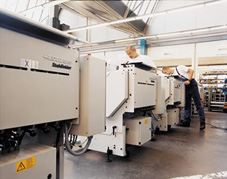
The Stahlfolder
Polar guillotines have been distributed through the Heidelberg network for some years. Known for their reliability, productivity and safety they are a vital tool in today’s busy workshop. Materials handling has enabled guillotines to keep pace in a graphic arts business where the combination of Computer to Plate and enhanced press throughput have put additional pressure on finishing. Heidelberg continues to stand by its belief that for every £1,000 invested in materials handling a 1% productivity gain can be achieved. Polar has created an important niche in the labels market with a range of die-cutting lines, launched at Drupa and gaining ground.
Compucut and Compu-fold are extending digital workflow into the finishing environment. These off-line programming systems can be used to connect to prepress and press. Compucut is installed at three UK sites. It is an ideal solution for complex label production, reducing guillotine programming time by up to 50% and increasing operational accuracy.
Jim Todd, sales director at Heidelberg UK, says: “Finishing is a key focus this IPEX. Many companies which have addressed digital workflow in prepress and press are now turning to the end of the line, recognising that only after finishing do they have sellable products. An error in this department is the most costly of all errors so machinery that is reliable as well as flexible and productive matters a great deal.”
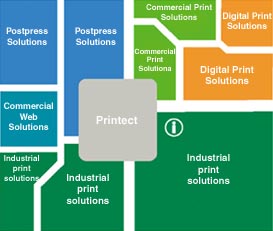
Exhibition map at IPEX 2002
We look forward to meeting you at IPEX 2002.
Heidelberg Graphic Equipment Ltd
658 Church Street
Richmond 3121
Victoria, Australia
Ph: +61-3-9205 4111
Fax: +61-3-9205 4211
www.au.heidelberg.com
or
www.heidelberg.com


 About half of Heidelberg’s finishing machines will be shown working as a “solution” with other prepress and press kit, with the remainder in a dedicated finishing area. This will be the first IPEX since Heidelberg acquired Stahl, a move which heralded a commitment to extend further the company’s presence in the finishing sector.
