Heidelberg Prepress at IPEX
Heidelberg will unveil its future workflow strategy in Birmingham based around common PDF (Portable Document Format) and JDF (Job Definition Formats). Its aim is to enable printers to maximise the data collected throughout the production and management chains by linking them together for maximum productivity, efficiency and profitability.
Heidelberg is developing a modular future platform to maximise
workflow potential. It continues to add to its know how and the capability of the component parts needed for effective workflow and believes in a PDF-based package which will help customers maximise the potential that integration brings. This would apply whether they work with conventional, Direct Imaging (DI) or digital printing machines.
Jim Todd, sales director of Heidelberg UK, says: “Integration will be one of the key topics of this IPEX as it is critical to the future of the industry. We have only seen the tip of the iceberg in integration to date. Many printers have adopted prepress to press (and press to prepress closed loop links) but the full potential of CIP 4 (the linking of prepress, press, postpress and business functions) has yet to be realised.”
Prinance, Heidelberg’s new Management Information Software marks the first linking in of a business software resource. Prinance will offer comprehensive business solutions from estimate to invoice, materials management, customer data, job costing and shopfloor data collection. It is ideal for small to medium sized companies with up to 100 employees.
“The key issue is the integration of business information and production; this is the move from CIP3 to CIP 4 that the JDF standard has made possible,” says Mr Todd. “Using job tickets allows information to be shared up and down the production line and into commercial and management functions.”
Prinance can be connected into CP2000 press controls directly. It allows order and estimate information to be transferred to production quickly and easily and for production data to be assessed and management information generated.
Heidelberg CTP goes visible
It is just not software that changes this IPEX. Computer to Plate (CtP) moves to a new plateau as Heidelberg gives its first international platform to visible light as well as thermal technology, the Prosetter range alongside the Topsetter range with products in both areas in B1, B2 and B3 format.
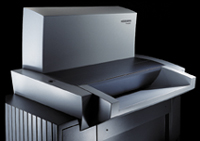
The Prosetter 52
In a world in which so far only big players have converted to metal CtP Heidelberg hopes to match its dominance in the thermal market with the leading role in violet CtP technology. The Prosetter is an internal drum solution which uses 405nm violet laser to produce resolutions of 2,400, 2,540 and 3,386dpi. The devices are compact and easy to use in bright safelight conditions.
Mr Todd says: “Heidelberg sees a strong future for both thermal and blue-violet laser technology because each has its own unique benefits. Blue-laser is a low cost CtP solution but the print quality is comparable to thermal. To date limited consumables supplies has hampered growth but with more plate options due to come on stream over the next months the situation will change.”
To further support its customers more effectively Heidelberg is becoming more active in the consumables market and has enjoyed huge success, with exceptional volumes being shipped in the UK and other key markets recently, so IPEX could also be an opportunity to discuss film and plate contracts and package deals.
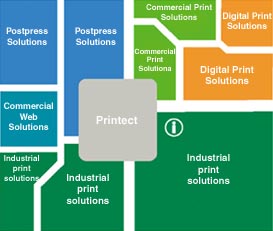
Heidelberg at IPEX 2002 - Hall 5 and 8
Hope you are having a great IPEX 2002!
Heidelberg Graphic Equipment Ltd
658 Church Street
Richmond 3121
Victoria, Australia
Ph: +61-3-9205 4111
Fax: +61-3-9205 4211
www.au.heidelberg.com
or
www.heidelberg.com


