Heidelberg – the once and future company
The Heidelberg Print Academy stands some distance from the entrance to the old town of Heidelberg in southern Germany with its quaint university precincts of narrow streets, dotted with16th century church steeples, clustering under the brooding hulk of a picturesquely ruined schloss. The Academy is an award-winning structure of soaring glass and steel surrounding a ‘silo’ of empty space, that stands symbolic of Heidelberg Druckmaschinen’s aspirations to be a leader among Germany’s hi-tech corporations.
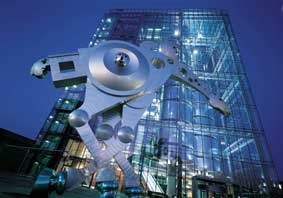 It is in the right location – Heidelberg is the technology capital of Germany with significant biochem, IT, software and media corporations located there, as well as NATO headquarters. In addition to its role as an international training centre for the graphic arts industry, the PMA functions as a social locus, boasting a Michelin star restaurant on the top floor, ’Schwartz’ and a convivial bar on the first floor that acts as a meeting place for people from all over the globe. Outside on the pavement a 12-metre tall aluminium ‘horse’ rears and stamps in sculpted kinetic rage.
Scorched by the firesale
As well it might. It has not been an easy time for the leader of the sheetfed press manufacturing industry. During 2004 Heidelberg disposed of its digital printing division as well as its web press division; the latter to Kodak, the former to Goss. Although part of an overall strategy to realign the company back to its core competencies, the transactions could not be described as lucrative. In the case of the digital division no money changed hands, with Kodak taking back the black & white digital business it sold to Heidelberg five years before. It also assumed responsibility for the ownership and continuing development of the NexPress, the high-end digital production press jointly owned by the two companies. There is a performance-based agreement for periodic payments to Heidelberg, to a maximum of $150 million, if certain sales targets are met.
The Goss International deal is scarcely less onerous, with Heidelberg transferring its sizable web press manufacturing division for 15 per cent share of the enlarged company. Not a bonanza by any means.
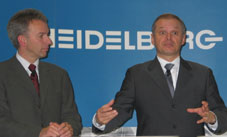 And yet, at the annual end of year press conference in Heidelberg in December, Bernard Schreier, CEO, (at right) and his new board member, Jürgen Raufert, were not dismayed by what could easily be described as a catastrophe. Rather they were in good spirits, like men who have come through the fire and survived. Yes, they freely admitted, the sale was not easy or pleasant and there were costs – hundreds of millions of dollars (an estimate puts it over euro500 million [AUD$860 million]). Even now with much of the pain behind it, the reduced company has posted a 2nd quarter loss of Euro 59 million, while declaring its continuing operations are expected to generate a small net profit of Euro 4 million. It’s not a great result, but it is better than expected and quite enough to convince the Heidelberg board that its decision to cut loose the loss-making operations was correct.
Run too fast, fly too high
That Heidelberg was forced to such drastic action is really not so surprising. Like the printing industry itself during the past decade it proved to be the victim of unfettered ambition to grow beyond its means. As the printing industry increased its production power to the stage where it is now suffering from chronic over capacity worldwide, so Heidelberg under previous management got caught up with plans to take over the world of graphic arts. It wanted to be number one not only in its traditional sector of sheetfed press manufacturing, but also in finishing, prepress, digital printing, web presses and even newspaper presses. In short, it wanted to be first in everything.
At the millennial drupa 2000 such hubris reached its apogee with Heidelberg amazing the world with a full-scale newspaper press in operation, massive sheetfed presses, new digital engines and a plethora of new models and developed technology that took up two crammed full exhibition halls. For a brief moment it seemed as though Heidelberg could indeed take over the industry. It was a great party, but it was doomed to come to an end. In the painful light of a 9/11 dawn the economic bubble burst, the economies of the developed world slowed dramatically, the graphic arts industry went into a painful slump, Heidelberg’s top management took the last train out and its new team was left to find a way to stem mounting losses that almost threatened the survival of the company.
At the same time the company’s power utility parent, REW, made it plain that it wanted to sell off its controlling interest in the loss making press manufacturing subsidiary. This could only take place if Heidelberg was whipped into better shape, with a coherent strategy that would appeal to international investors. And so began the year of hard decisions.
Came the dawn
Heidelberg at the start of 2005 is a vastly different company than the vulnerable, over extended corporation entering last year’s drupa cycle. It is now a company back in control of its destiny, fully publicly owned, focused on what it does best – the manufacture of sheetfed printing presses, the prepress equipment required to feed them, workflow to automate them and finishing equipment to complete the cycle. It is has cut staff, closed facilities, shortened hours, slashed costs and streamlined its management. It is now looking at exploring manufacturing options in China, initially to assemble folders but with an eye on long-term press manufacture there. More importantly, it is re-creating itself as a service and consulting company as well as a manufacturer.
The language used along the corridors and in the workshops at Heidelberg now is down-to-earth, focused on the nitty gritty of printing with little of the hyperbole that characterised its flaming ascent. Proactive service and customised presses are the centre of attention, bottom line profits for its customers and a determination to retain its dominance in the sheetfed market are the messages coming from its executives. Packaging is attracting more of Heidelberg’s attention as the digital revolution continues to sweep across information printing. Consolidation is decimating its customer base – in the five years to 2005 up to 30 per cent of printshops in Europe will disappear.
Do you want die cutting with that?
In response Heidelberg foresees printers developing specialisations, exploiting niche markets with specialised equipment. The company is moving away from relying on production model presses, a one size fits all approach, to promote the benefits of customisation.
The world longest sheetfed press is currently being installed at a secret location in Germany. Designated as a CD102-LY+8+YLYLY+1X3, the 16-unit Heidelberg press is designed for a wide variety of applications in commercial printing, but with an eye on packaging and label processes. It has two flexo units before eight offset units ahead of an additional five flexo units and a final offset unit for matt coating. This is a seriously customised press and indicative of the lengths printers are now prepared to go to gain differentiation in the market. It is not a press for everyone and as Jürgen Rautert said, “a printer entering that field should verify in depth his job structure. A machine going to these extremes has limited resale options.”
On the other hand the Heidelberg team of approximately 50 specialists that develops these customised presses has the ability to remake any size machine. The smallest customised model is a Speedmaster 52 with coater, UV dryer and inline die cutting. Currently running in the UK it is massively productive machine when compared to offline processes. “Such a machine has a limited number of jobs you can run on it, but that’s the nature of customising – tailor-made solutions for profitable niches,” reaffirmed Rautert.
Are you being system served?
With its field of action curtailed to the offset sheetfed printing market, Heidelberg is determined to develop new proactive service models that cover the entire production process. As the only major press manufacturer with its own prepress (it has just released the first wholly Heidelberg developed thermal platesetter, the SupraSetter) and its own finishing line, it is in a unique position to develop an end-to-end production service concept. Working on the basis that three to four per cent of print sales are used to cover print shop service costs, which doesn’t include production downtimes, it is Heidelberg’s contention that with its service extending to the printer’s entire value-added chain in sheetfed printing, it can significantly lower the total cost of ownership while ensuring a transparent price/performance ratio.
It is sometimes easy to forget just how widespread the Heidelberg influence in sheetfed printing actually is. With more than 200,000 customers and 40 per cent of the market it has 5,4000 sales and service specialists at 250 branch offices in 170 countries. From its global logistics chain it dispatches 5,000 deliveries of parts per day.
As part of its system service model ,Heidelberg is promoting a new print quality test complete with test form and assessment performed by its own specialists. A business simulation tool, BizModel, will allow customers in partnership to pinpoint potential areas where production can be improved.
The pragmatic realignment of Heidelberg is a realistic response to an untenable situation. The new corporate model may lack some of the media fizz of the glory days when it seemed the convergence of communication technology would position the printing industry as the key knowledge manager of the future with Heidelberg as its handmaiden. It may still happen, but if the Heidelberg experience is anything to go by it will not happen overnight and in the meantime survival is essential – for the company and its customers.


 It is in the right location – Heidelberg is the technology capital of Germany with significant biochem, IT, software and media corporations located there, as well as NATO headquarters. In addition to its role as an international training centre for the graphic arts industry, the PMA functions as a social locus, boasting a Michelin star restaurant on the top floor, ’Schwartz’ and a convivial bar on the first floor that acts as a meeting place for people from all over the globe. Outside on the pavement a 12-metre tall aluminium ‘horse’ rears and stamps in sculpted kinetic rage.
 And yet, at the annual end of year press conference in Heidelberg in December, Bernard Schreier, CEO, (at right) and his new board member, Jürgen Raufert, were not dismayed by what could easily be described as a catastrophe. Rather they were in good spirits, like men who have come through the fire and survived. Yes, they freely admitted, the sale was not easy or pleasant and there were costs – hundreds of millions of dollars (an estimate puts it over euro500 million [AUD$860 million]). Even now with much of the pain behind it, the reduced company has posted a 2nd quarter loss of Euro 59 million, while declaring its continuing operations are expected to generate a small net profit of Euro 4 million. It’s not a great result, but it is better than expected and quite enough to convince the Heidelberg board that its decision to cut loose the loss-making operations was correct.