HP opens floodgates with new digital offerings – Magazine feature
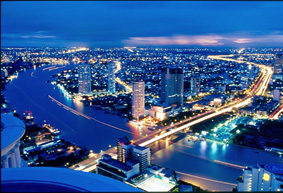 A new Indigo label press and a range of new Designjet wide format engines were the high spots of a technology showcase in Bangkok that saw HP take the wraps off a number of solutions for the graphic arts industry. Angus Paterson went to Thailand's capitol witness the rollout, cautiously avoiding the other coup taking place there.
A major element that surely would have inspired HP to stage this event in Bangkok is its status as one of the biggest wide-format cities in the world. The number of massive billboards by the side of the freeways is simply staggering, as are the extravagant building wraps that plaster the skyscrapers from top to the bottom - many featuring colourful images of the country's revered king in celebration of his 60 years on the throne.
Industrial inkjet has clearly become a major focus for HP, and Bangkok printer Q-Ads is responsible for producing an amazing 80 per cent of the city's billboards and building wraps - out of a modest factory space dominated by HP technology. But the main focus was on HP's other digital engines like Indigo and Designjet, and how the technology giant is planning an aggressive drive into a number of new market segments.
Revving up the digital transformation
Christopher Morgan, regional vice president of imaging and printing for HP, kicked off the event by riding in on a Harley Davidson to the strains of Born to Be Wild in the grandiose fashion typical of such marketing junkets. The motorcycle was even plastered with colourful decals printed using - you guessed it - HP technology, as were the buses used to transport visiting journos around the streets of Bangkok.
Morgan pointed to the continued shift from analogue to digital as the source of future growth and revenue for HP. Internal research from the company suggests that while in 2005, eight per cent of the 46 trillion pages printed were produced using digital technology, this figure is set to rise to ten per cent by 2010.
Morgan re-emphasised his company's commitment to the industry, a dedication driven by its investment in research and development. HP wants to be 'middle man' that allows print service providers to communicate with agencies and publishers, and one of the biggest means to this end is the company's 'alliances' with third-party providers to provide the necessary software and media solutions.
Some of these partnerships include Adobe, DirectSmile, X-Rite/GretagMacbeth, EFI, GMG, Hahnemuhle and Avery Dennison.
Digital label production booming
Steve Donegal, digital press business manager for HP in the Asia Pacific, has a history with the Indigo machines that stretches back more than a decade. While he began his career in his home country of the UK, he now works out of an office located on Sydney's Northern Shore.
HP is the world's top supplier of digital label presses, with Xeikon currently its only real competitor. HP is gunning to be one of the top three players in the overall narrow-web label market by 2007. Along with HP, firms like Kodak, Canon, Agfa and Fuji Xerox are all seeking to accelerate the conversion from offset to digital, and with digital crossing over into the mainstream these efforts are beginning to yield real results.
“You can see how we are now moving into a position of strength, because providers are facing such a changing environment that they are looking for the technology to help take them to the next step,” says Donegal.
The latest addition to the Indigo range is the ws4500, officially unveiled to the public at Label Expo in Chicago (see Label Expo report this issue). The press strengthens the base provided by the ws4050 with a number of new features to encourage further automation and streamlining of the production process. This includes allowing the spot colour ink cartridge to be replaced without stopping the press, a significant reduction in operator intervention. Other innovations include the 'traffic light' indicator that tells the operator what press issues they need to address, in order of urgency.
There is support for an expanded range of label media and HP promises compatibility with a wide range of coating and finishing solutions.
“We asked our customers what they wanted to see in terms of new developments, and we believe we have delivered on most of these requests,” says Donegal. “It completes our arsenal, and allows us to lead in terms of offering end-to-end packaging solutions. Watch the marketplace closely, because this is going to be the next big thing for HP.”
Thai-tanic product launches
Apart from the new Indigo ws4500, the Bangkok event also saw the unveiling of a number of new Designjet models, including the low-solvent Designjet 10000s that can print up to 104 inches (2.6 metres) wide, and the Z2100 (8-colour) and Z3100 (12-colour) Designjet machines that are targeted for graphic designers, proofing, professional photographers and digital fine art.
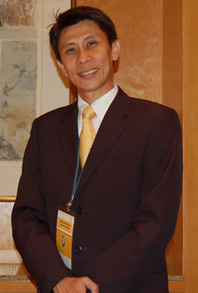 Michael Phoon, director of large format printing and imaging for HP (pictured right), explained why his company decided to release such a diverse range of graphic arts equipment simultaneously.
“HP has been consistently building and shaping its R&D in the background, preparing to explore a number of new market segments,” said Phoon. “But instead of having a fractured introduction and bringing in new products here and there, we wanted the graphic arts community to understand that we have a solution that fits the needs of everyone - whether you are an agency creative, a professional photographer or a commercial printer. And we want to be careful that we are providing the right solutions to the right people, rather than just rushing the products out to the market.”
With its new 'Z' series of Designjet printers, available in 24” and 44” widths, HP is making a renewed effort to offer solutions to prepress and proofing professionals, effectively going head-to-head with Epson and its successful range of Stylus Pro inkjet printers. One major innovation is the built-in Eye One spectrophotometer on 'Z' printers. This is significant because prepress and proofing are segments that HP had previously not enjoyed a majority market share.
Intent on proofing a point
“The Designjet has traditionally been focused on the technical CAD/GIS marketplace. Architects, mapping, seismology, they're all using Designjets,” said Phoon.
“But now we're turning our attention back to the proofing market and with the built-in spectrophotometer, we are poised to be very successful with that.”
The inbuilt spectrophotometer is the result of a partnership with colour management specialists X-Rite/Gretag Macbeth, and it allows a hands-off approach to ensuring colour accuracy and implementing ICC profiles. Importantly, it will allow HP to stage an assault on the professional photographer market, Where Epson claims 71% market share.
“Many photographers are currently looking for the first time at taking the printing process into their own hands,” says Phoon. “Colour management is intimidating, but the inbuilt spectrophotometer takes it out of their hands.
“Producing their own prints can be a great revenue source. Often it was thrown into the too-hard basket, but now we are offering a complete colour-managed solution that enables them to do that.”
Chasing new photo and signage markets
To showcase its new range of Designjet 'Z' printers HP enlisted the services of Douglas Kirkland, celebrity photographer and photojournalist, best known for his iconic portraits of Hollywood favourites like Jack Nicholson, Angelina Jolie, and Katherine Hepburn and famous for kicking off his career nearly 50 years ago in an intimate shoot with Marilyn Monroe.
He noted that the spectrophotometer on these new printers (officially launched at Photokina, Germany on September 26th), automatically creates ICC profiles and frees up photographers and artists from getting bogged down in difficult colour management work.
The Designjet Z2100 uses an eight-colour ink system that includes three blacks. However, the Designjet Z3100 runs with 12-colours including Quad-Black inks designed for faithful grey neutrality, continuous monotones and rich blacks. The Z3100 is intended as the flagship model for critical colour in all applications, including proofing.
However, the star of the Designjet show was the new 10000s low-solvent model. Tailored for the signage market, it is capable of printing high-quality signs, outdoor banners and large graphic printouts up to 2.64 meters (104 inches). This means it effectively functions as a bridge between the Designjet range and industrial inkjet solutions from the HP Scitex division.
Output from the Designjet 10000s can resist fading for up three years without lamination, high-speed output made possible by six 512-nozzle piezo printheads. Media-handling abilities are enhanced with its take-up reel supporting two preloaded rolls for side-by-side printing and longer, unattended runs, and it is efficient with both double-sided and dual-roll printing. It can print directly onto unbacked mesh and uncoated media like adhesive vinyl, scrim banners and other super-wide substrates.
“Keep on printing”
HP's Bangkok bash was wrapped up with a presentation from Tony Chambers, creative director Wallpaper* Magazine - considered one of the most influential design publications in the world.
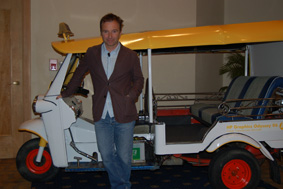 Speaking from a designer's perspective, Chambers (pictured right) has faith that print will be able to hold its own against emerging forms of electronic media. “Though the death of print has often been predicted, we need more than a fast food approach to publishing,” he said, “because there are often times when we want to digest things with a little more substance.”
“I predict that a renaissance in the printed product is close, and it will be led with a bigger focus on visual presentation and tactile feel.” Stylish finishing techniques like folding, die cutting and varnishing are what Chambers claims can give print a leg up in terms of presentation.
Coupled with an assertion that those working in printed media might have to work a little harder and a little smarter, he urged the graphic arts industry to; “keep on printing.” With a forecast as upbeat as that, printers may just be embarking on a new Odyssey of their own.


 A new Indigo label press and a range of new Designjet wide format engines were the high spots of a technology showcase in Bangkok that saw HP take the wraps off a number of solutions for the graphic arts industry. Angus Paterson went to Thailand's capitol witness the rollout, cautiously avoiding the other coup taking place there.
 Michael Phoon, director of large format printing and imaging for HP (pictured right), explained why his company decided to release such a diverse range of graphic arts equipment simultaneously.
  Speaking from a designer's perspective, Chambers (pictured right) has faith that print will be able to hold its own against emerging forms of electronic media. “Though the death of print has often been predicted, we need more than a fast food approach to publishing,” he said, “because there are often times when we want to digest things with a little more substance.”