Lies, election claims and damned statistics
Those following the federal election campaign would no doubt have noticed that economic management is being promoted as a key election issue by both the government and the opposition. There have been a number of claims and counter claims on this pivotal pre-election issue. So which political party can claim credit for being responsible for good economic management in recent decades? To answer the question I examined the economic data of recent Australian governments led by Whitlam, Fraser, Hawke/Keating and Howard covering a period of more than 30 years.
Economic Growth
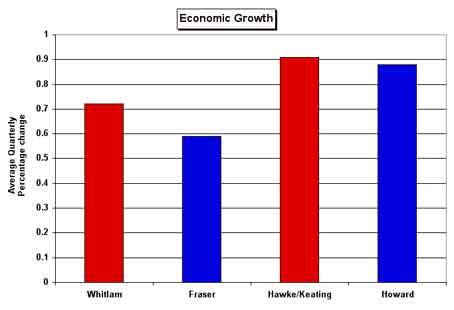
The Hawke/Keating governments produced the highest average rate of economic growth at 0.91 per cent per quarter, followed by the Howard government at 0.88 per cent. The chart depicts the performance over the past 30 years.
Labor governments on average have delivered higher economic growth rates than government’s led by the Coalition.
Consumer Price Index
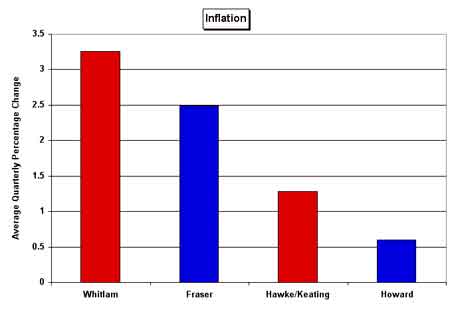
Coalition led governments have a distinct advantage when it comes to managing inflation. The best performing government over the past 30 years has been the Howard government with an average quarterly inflation rate of 0.60 per cent followed by the Hawke/Keating governments during which period the average quarterly inflation rate averaged 1.28 per cent. The chart depicts the performance on the inflation front.
Unemployment
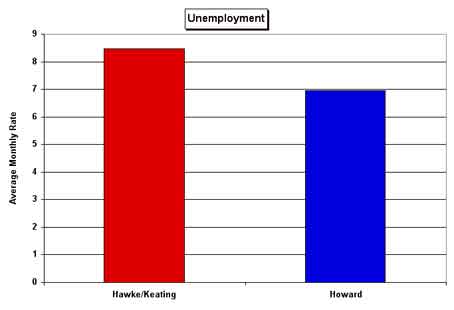
With the definition of what constitutes employment and unemployment changing significantly the comparison below was limited to the Hawke/Keating and Howard governments.
The Howard government has outperformed the Hawke/Keating governments when it comes to unemployment. The outcome no doubt has been aided by the absence of a serious and prolonged economic downturn during the period of the Howard government.
Net foreign Debt
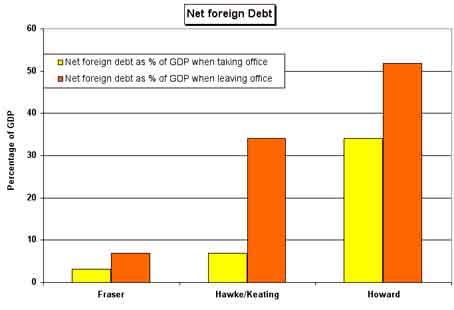
No recent federal government has managed to control net foreign debts during the period that they have been in office. Governments led by Fraser, Hawke, Keating and Howard have all presided over rising net foreign debts as a percentage of the economy as shown by the chart below.
Current Account Deficit
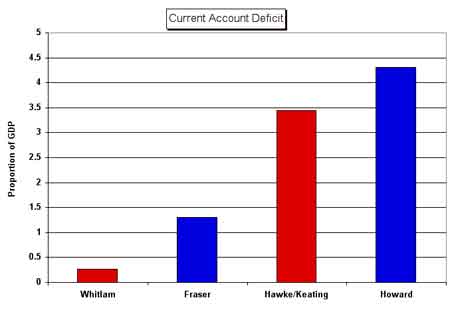
The poor performance in the area of foreign debt is partly attributed to poor performance in the area of the current account deficit, which measures trade flows in goods and services and the transfer of incomes. The current account deficit as a percentage of GDP has deteriorated significantly as shown below.
Labor led governments have outperformed their Coalition counterparts.
br>
Home loan rates
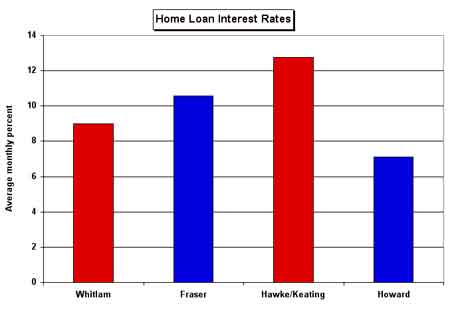
The Howard government can take credit for presiding over a low interest rate environment as shown by the chart below. Generally speaking it would be true to say that Coalition governments deliver lower interest rates. The average monthly home loan rate under the Fraser and Howard governments has been 8.83 per cent, compared to 10.87 per cent for the governments led by Whitlam, Hawke and Keating.
Budget Outcome
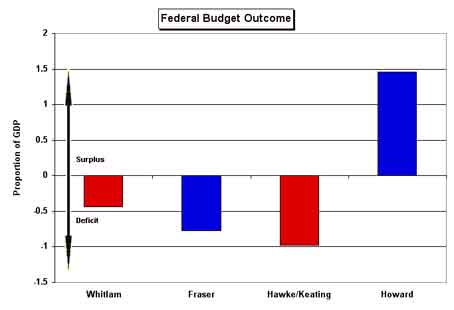
The final area examined is the fiscal balance which shows the Howard government outperforming its predecessors.
Under the Whitlam, Fraser, Hawke and Keating governments, the average budget outcome was a deficit; a situation that has been reversed under the Howard government.
Sustainable rates of economic growth combined with record levels of taxation revenue as a proportion of GDP, have helped the Howard government to deliver fiscal surpluses on average during its term in office.
The economic debate in Australia in recent times has been dominated and influenced by advocates of fiscal surpluses. Both the Labor party and the Coalition are now committed to delivering fiscal surpluses during their term in office. My own view is that while it is desirable to run a surplus during times of economic expansion to help reduce debt and consolidate the fiscal position, it is bad economics to aim to produce a surplus every time.
There will be occasions which will justify running a budget deficit such as when the economy is experiencing a severe economic downturn. The failure to stimulate the economy under such circumstances would be as economically irresponsible as running budget deficits during periods of strong economic growth.
Governments must also constantly allocate funds to infrastructure related projects which may from time to time temporarily send the budget into a deficit. In such cases the short term cost of a budget deficit is more than offset by long term economic benefits generated by such investments in infrastructure.
Like all government policies, fiscal policy too must be flexible to be effective. Unfortunately the current fetish for budget surpluses irrespective of prevailing economic conditions does not only promote policy inflexibility but is also bad economics.
Conclusion
Who manages the Australian economy better? Governments led by Labor or the Coalition parties?
If you preference is for faster rates of economic growth then you might be prepared to give your vote to Labor. On the other hand if you value lower inflation, unemployment and interest rates than the Coalition is likely to get your vote.
Surprisingly in the area of net foreign debt and the current account deficit, the performance of the current Coalition government has been worse than its Labor predecessor.
Finally, Coalition led governments seem to produce better fiscal outcomes than their Labor counterparts.
As can be seen from the above analysis, no major political party can claim to have a monopoly on delivering superior economic outcomes. Some have performed well in some areas of the economy while performing deficiently in other areas.


