New Zealand print conference at Lake Taupo – Patrick Howard reports
Patrick Howard writes from the conference.
Day One. Dateline Wairakei, Thursday 12 October
There are more than 230 printing industry types here, which is a lot, and what’s most surprising is that a lot of them are actually printers. Normally at these industry conferences it’s wall to wall suppliers, reps trying to chummy up with their customers, marketing types spruiking their products and senior management skiving a couple of days away to play golf. I’ve been at conferences where they couldn’t raise a team of printers to take on the suppliers at table tennis.
But here at the Wairakei Resort, situated in the area where they filmed lots of Lord of the Rings – there’s a steam farm across the road with natural geysers and it’s easy to imagine you’ve spotted a hobbit darting back into the pine trees – printers are everywhere. For people who are supposed to be doing it tough they’re a fairly relaxed and gregarious bunch, and keen to learn about the changes to their industry. That’s what the conference is about, Focus on the Future and again, titles such as this are stock in trade at industry events and usually they don’t mean much, but Joan Graces’ team have taken it to heart. The conference is actually about what the industry will be like in the near and not so near future.
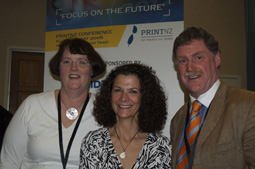
It kicked off this morning with Joan herself, and Warren Leslie (pictured flanking keynote speaker, Margie Dana), president of PrintNZ, running through some results of a benchmarking survey done by members. The news is mixed; numbers of businesses are down, from 5389 to 4966, but for those that remain it is growth time, with most determining to invest in equipment and increase staff. But it’s not an industry that’s on a huge growth path; in the past few years the NZ economy grew by 19.5 per cent while printing staggered along at 5.3.
But then return on assets is greater than in the wider economy, although Leslie suggested this may be because we’ve depreciated the equipment to nothing over the years. Still, overall it was a fairly upbeat intro to the conference.
Margie Dana
Opening keynote speaker was Margie Dana from Boston Print Buyers. A diminutive, big-voiced American, she had plenty to say that made sense about keeping your focus on the customer. A print buyer herself for 15 years, when she started she was untrained in everything to do with buying print. Which is the point -– so are all the other US college-educated women who buy print, and that’s the majority of print buyers. Dynamic and sincere, she professed to be heartbroken at the state of the industry in the US where 63,000 printing companies have been chopped to 40,000 in the past five years.
She made the uncomfortable point that many, if not most of the young print buyers now ‘google’ for printers. If you think that’s heresy, she also said that no one is going to care about the quality of the print, it is assumed you can turn out a good job, otherwise why be there?
She said US printing companies are morphing into undefinable enterprises, taking the word ‘print’ out of their names, becoming ‘marketing services’ firms, anything to differentiate. In true conference-speaker style she finished off with 15 points of advice to get closer to your customer, to communicate better, to keep the channels open. These included such items as establishing a Customer advisory board, organise open houses, invite customers to a lunch and learn session every quarter.
OK, it’s not rocket science but it’s recognised more in the breech than in the observance. She’s absolutely right, it is all about the customers and the beauty of speakers such as Margie at conferences such as these is that it makes you realise as much.
Dave Nottage
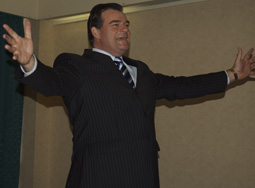 The conference is split into three streams, technical, business and customer interface. After the opening session I headed off to hear the best speaker of the day, Dave Nottage (pictured). Not surprising he’s a good speaker really; he’s a world champion of Toastmasters. His Presentation Skills presentation proved worth the price of admission. His theme was glossophobia (fear of public speaking) and some tactics to overcome it. 90 per cent of English-speaking people have a morbid fear of getting up in front of people and speaking in public. His practical seminar had us rolling in the aisles while picking up invaluable tips. From the um err! game to the KMS keep mouth shut tactic, he made it all seem if not easy then at least more than possible.
Dr Ian Brown
Dr. Ian Brown is the kind of customer service guy that tells a young cop who pulls him up for speeding that he is overly familiar in calling him by his first name. He rebukes a security guy at LA airport for not being polite enough. He’s a serious customer service person. My next stop on the day’s conference journey told me that it’s no longer about customer service or customer satisfaction -– it's about The Experience.
A hugely knowledgeable Canadian, the good doctor is clearly exasperated by companies that don’t get it. He slammed into banks, telcos, and supermarkets – everyone except printers – for not taking care of their customers. Showering statistics of customer dissatisfaction from around the world, he pointed out that customers don’t complain, they move on; they are never asked how they want to be addressed and they suffer most of all from the effects of management’s delusions of adequacy. A cold shower for anyone who thinks they are looking after their customers well enough.
Eric Kenly
Living in Phuket and travelling the world for his company, I O Technologies – motto, Helping people to think for themselves – Eric Kenly is a man who believes in competition. He adopts a high tech response to the needs of today’s printing businesses in their quest to transform themselves. Replete with such marketing tools as ANOVA (Analysis of Variance) he urged printers to “get an A” when talking to their new customers, to understand the metrics of the marketing world and to learn the new skills, such as programming, that will be necessary to make the transition to a new way of doing business. A challenging and tough presentation and not a place you might term the comfort zone.
Daniel Amato
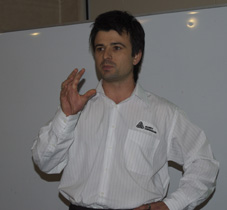 My only venture into the technical workshops during the day was to hear Daniel Amato from Avery Dennison (pictured) on the future of RFID labels (radio frequency identification). A fine example of a proactive audience, Daniel never did get to finish his presentation as the audience took him up on his invitation to ask questions as he went along. RFID is such a new technology and one with such obvious potential that the people there wanted to know exactly at what stage the introduction was at.
The answer, that New Zealand and Australia are way behind the US and Asia in introducing RFID, merely sparked further questioning as to how, where, when and why. The role of the integrators, Avery Dennison and the large corporates all came under scrutiny and we came out sharing an impatience to bring it on.
Prof Thomas Bley
Maybe it was because he was the last speaker of the day, maybe because he refused to put design into a nice little box, but the Prof proved hard going for me. Head of the Department of Design at the University of Otago, he is obviously passionately involved with protecting the creativity and intuition that is essential in design. Maybe by definition design is recognised more by what it is not than by what it is i.e. invisible, but I could have done with more examples what he thinks good design is.
I know there are many chairs in the world and maybe we don’t need another design, but we will get one. I wanted him to tell us what might be some of the elements of suitability, what a designer might consider in preparing for the task. Maybe it was time to go back to the room and get ready for the cocktail party that evening.
Which I did.
Day Two. Dateline Waikerie. Friday 13 October
It’s always a challenge to get the numbers for the opening session the morning after the conference dinner. Fine New Zealand food and wine and convivial company saw many of us repair to the bar and stay later than we ought. But they’re a resilient bunch, the Kiwis, so a goodly crowd shuffled in this morning to hear David Perchard from the U.K. paint the big picture on environmental sustainability.
A laidback type of bloke with a well-defined line in gentle skepticism, he took us through the ramifications of the European Union environmental initiatives. The Brussels bureaucracy seemed a long way from the pristine surroundings of Lake Taupo, but he framed the likely effect of such NGO initiatives as food miles and packaging biodegradability. Any campaign to discriminate on the distance food has to travel to the table will obviously have a major impact on New Zealand’s industry.
He gave some alternative ways of calculating the energy consumption i.e. the real cost of getting New Zealand lamb to British tables and the news is not all bad. But he did convey a sense of the blind determinism of bureaucracy when it is looking for easy outcomes.
One fascinating insight came with a list of the household activities on the energy supply. In this calculation packaging came second from the end, well after such items as food, travel and home heating. However, when individuals were asked what they could do to reduce their impact on the environment, recycling and cutting down on packaging came first. It goes to show that if ever policy making is captured by the need to play to the populace, we can expect some detrimental and discriminatory sanctions passed against the printing and packaging industries.
And that was it for me. The next session I was booked into cancelled. I’d attended the alternative speakers' presentations, so I give it a swerve and left to make the three hours drive back to Auckland airport.
A great conference and a model as to how these things should be organised. If you get a chance in two years time come along to the next one; it’s well worth it. Hopefully I’ll see you there.


 The conference is split into three streams, technical, business and customer interface. After the opening session I headed off to hear the best speaker of the day, Dave Nottage (pictured). Not surprising he’s a good speaker really; he’s a world champion of Toastmasters. His Presentation Skills presentation proved worth the price of admission. His theme was glossophobia (fear of public speaking) and some tactics to overcome it. 90 per cent of English-speaking people have a morbid fear of getting up in front of people and speaking in public. His practical seminar had us rolling in the aisles while picking up invaluable tips. From the um err! game to the KMS keep mouth shut tactic, he made it all seem if not easy then at least more than possible.
  My only venture into the technical workshops during the day was to hear Daniel Amato from Avery Dennison (pictured) on the future of RFID labels (radio frequency identification). A fine example of a proactive audience, Daniel never did get to finish his presentation as the audience took him up on his invitation to ask questions as he went along. RFID is such a new technology and one with such obvious potential that the people there wanted to know exactly at what stage the introduction was at.