


New Zealand rises to Challenge of Change
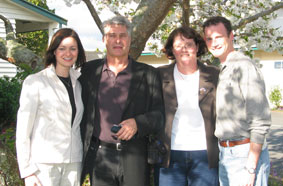 According to Joan Grace, ceo, (pictured 2nd from right with conference presenters Trish Witkowski, Gary Donnison and Mark Witkowski ) the Association’s ambitions were more than realised and a solid foundation was laid for future events. “Everyone I’ve spoken with is pleased with the way it has gone. The speakers were very good and I think we gave those who attended something to think about and to take away with them to their businesses,” she said.
Over three days at the Wairiki resort, participants were treated to a world-class event with presentations from such international identities as Andy Tribute (UK), Trish and Mark Witkowski (USA), Les Bovenlander (Hong Kong) and a phalanx of Australians, including marketing guru Malcolm Auld, CTP expert Ross Gilberthorpe, enviro activist designer Helen Lewis, and Gary Donnison, ceo of Printing Industries.
The local presenters more than lived up to the challenge with motivational speaker, Deb Gilbertson, energising everyone for miles around with her irreverent brand of wit and wisdom, while All Black coach, Graham Harry held forth at the conference dinner on what troubles the national rugby team.
Why hasn’t anyone done it before?
Perhaps the most eye-opening presentation of all was Trish Witkowski’s enthusiastic account of her love affair with folding, the essential but often overlooked part of the printing process. Few in the audience were not influenced by her infectious enthusiasm for all things that can be creased, scored, bent and guillotined.
As creator, along with husband Mark, of the recent GATF Award winning FoldRite system, the designer and author of the industry bible FOLD, gave a fascinating account of how her master’s thesis grew into a seven-year Odyssey that has broken new ground and laid a foundation for a industry-wide standardised system of folding. Hard to imagine that at this stage of the printing industry’s history such an influential project can be the work of one person.
Her palpable joy in discovering, collecting and exhibiting rare and usual examples of folding imbued everyone in the room with new ways of looking at everyday objects. The demonstration of how designers and printers can download templates from the www.foldfactory.com and a ‘conference special’ six-month free membership proved to be one of the most useful outcomes of any recent graphic arts conference.
The ability to download templates, folding or otherwise, was the theme of Mark Witkowski’s address. Describing his occupation as ‘digital technology strategist’ for the Sheridan Group of printing companies on the East Coast USA, he focused on the migration of programs to the web in the shape of ASPs, or downloadable software sites.
As the designer of the foldfactory.com he is in a pre-eminent position to scope the shift to ASPs and gave examples of three other different types of technologies, other than folding, that are available.
 According to Joan Grace, ceo, (pictured 2nd from right with conference presenters Trish Witkowski, Gary Donnison and Mark Witkowski ) the Association’s ambitions were more than realised and a solid foundation was laid for future events. “Everyone I’ve spoken with is pleased with the way it has gone. The speakers were very good and I think we gave those who attended something to think about and to take away with them to their businesses,” she said.
These are the type of sites that are set to change the way the industry buys its software and works its processes.
Moving to the web
Ross Gilberthorpe, KPG, proved to that rare breed – a sales rep who successfully resisted the urge to flog his own wares in front of an audience. Tasked with giving an industry overview of the choices in, mainly digital, proofing, he provided an admirably clear introduction to the minefield of toner versus inkjet, softproofing versus digital halftone, and analogue versus everything else. His mantra that it all depends on what you are trying to achieve made rock-solid sense.
He shared the time, (well, hogged it a little, truth be told) with the always cheerful Les Bovenlander down from Hong Kong for Real Time Image, the recent KPG purchase. Reinforcing the trend that more value is moving onto the web www.realtimeimage.com Les provided an introduction to virtual proofing on monitors, connecting to the company’s San Francisco site in real time, to provide a convincing demonstration that we are all going to have to adjust our thinking as these remote technology sites develop.
Not all about the technology
The conference theme of The Challenge of Change meant that much of the focus was away from technology issues and on to the challenges facing the industry in other spheres. Malcolm Auld gave a refreshing presentation on marketing, how and why it must be done. Ranging far beyond his specialty of direct mail, where he is the acknowledged master, he gave down to earth advice on how printers should speak to advertising agencies, with tactics on how to navigate around the production manager, the account manager, and the creatives to find the one person worth talking with. Often hilarious, his was a high-powered address that left the audience applauding for more.
On a different note, Helen Lewis of RMIT in Melbourne, gave an update on the state of environmentally responsible design. Justifiably taking a fairly sombre approach to the impact the printing industry is having on the world around us, she charted some of the design-based initiatives underway to limit the damage. She spoke to printers, papermakers and designers setting standards for the stewardship strategies that will either be industry responsibilities, or government-enforced rules, if we don’t seize the initiative.
In like mode Gary Donnison, ceo of Printing Industries brought his New Zealand colleagues up to speed with the progress of benchmarking for the industry, setting standards by which to operate. He used the successful Benchmarking Vol 1 from Australia www.printnet.com.au as an example and encouraged the local industry to follow suite.
New Zealand flavour throughout
It would be wrong to give the impression that the international speakers at the conference overshadowed the locals. Anthony Drake of the Association gave a fine presentation on dealing with employee fraud and the shifting employment landscape, while Jeremy Baker impressed with his well-argued plea for firms to invest in attracting high-quality employees.
But few speakers came near Deb Gilbertson for sheer value and entertainment. Taking her audience on an adventure in leadership she demolished stereotypes, slew sacred cows with abandon – especially management bovines – and gave a spirited account of how to get from vision to achievement in life and in business. Imbued with positivism she left at least one trans-Tasman attendee wondering why Graham Harry and not her had the job of whipping the All Blacks into shape. He kept the advice to himself on the basis that it would only be giving succour to the enemy to drop the hint.
All in all a great conference and one to whet the appetite for the next one in two years time.