Printers hunger for industry specific information
The hunt for suitable industry data remains the core focus of the Printing Industry Working Group’s (PIWG), following a meeting last month.
The need for industry data proved a common thread throughout all discussions, as the Group concluded that this type of information is a cornerstone to aid businesses make crucial decisions about their future. It also helps the industry better articulate itself to the Government.
According to Hagop Tchamkertenian (pictured), national manager for policy and government affairs at Printing Industries, printers need industry data to make crucial business decisions. They rely on it to decide what market segments to move into, or pay less attention to.
He believes official sources such as the Australian Bureau of Statistics can offer a macro picture of industry dynamics and what is happening in the economic community, but if people want to know where to invest within the  industry they need segmented data.
“Having market oriented data is essential for decision makers, especially those who have medium to long-term horizons in terms of strategic planning and direction.
“I hear reports of business within our industry trying to access funding for various purposes. They are increasingly finding it difficult, and if you want to go and borrow money for example, you have to present a business case,” he says.
Tchamkertenian notes that the availability of industry specific data would allow businesses to pursue such a case. The need for data is driven by the fact that lenders are reluctant to lend to what they deem to be a mature industry. “Having said that, while the industry is mature there are segments that are not such as digital printing,” he says.
Following on from the last PIWG meeting with the ABS and Printing Industries, the latter circulated an online survey to its members mid-October 2011, outlining the type of economic data currently available to the industry and ascertaining the type of data required. The goal is to find out what data is required to successfully operate a business, and where the data gaps are within the printing industry.
The survey results reveal that 56.9% of respondents use industry specific information to manage their business, while 41.5% found it to be of critical importance. Only 7.3% said such information was not critical.
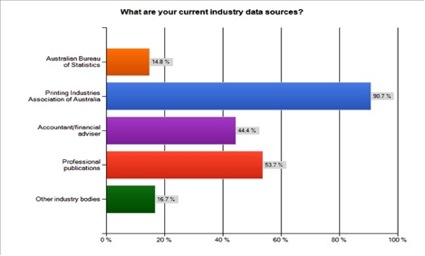
Over 90% of members indicated that the Printing Industries is their primary source of industry data, while only 14.8% cited ABS as a preferred source. Interestingly, PIAA members ranked professional publications, such as Print21, higher than financial advisers as a data resource, See graph below:
After examining the results PIWG has turned its focus on developing a data strategy. The work group feels that evidence demonstrating how historical events shaped the industry is not only important in and of itself, it can also be used as a basis for establishing what the future might hold.
Complementing this information will be any suitable industry data gathered from the Australian Bureau of Statistics, and Enterprise Connect’s new Printing and Publishing Industry support Network.
Another point raised by the PIWG, is that the industry must take the lead on client management before the 1 July 2012 carbon tax adoption date. To this end, Tchamkertenian says that printers need to get closer to their clients, offering solutions and developing relationships that are not just based on price.
“This means being a smart communicator in terms of business provisions, rather than just sitting back using the traditional model. You have to be proactive. While you can discuss what your technological offerings are, at the end of the day, technology is a given. It’s in the marketplace; if you have the money and the means, you can go and purchase it.
“What clients are looking for is how they can utilise that technology to migrate from a particular market space that they are currently in to another,” says Tchamkertenian.


 industry they need segmented data.