Promotional transaction printing on 24 iGen3s
High-end Australian Fuji Xerox transaction customers get a rare opportunity to see inside the trail-blazing JAIS printing facility in Japan.
The Fuji Xerox Platinum Partners tour of Japan last week culminated in an inspection of the largest iGen3 site in the world JAIS in Osaka. In a secure site over two floors of an Osaka office building, 24 iGen3 printers produce nine million personalised credit card statements over an 80 hour period once a month. The pioneering facility is at the forefront of a new form of promotional transaction printing, in which statements are personalised with advertising messages based on the recipient's credit card usage.
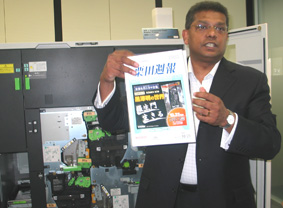
The Tour was hosted by Nick Kugenthiran, general manager production printing FX Australia (pictured right) and included Fuji Xerox's top ten service bureau customers in Australia, as well as myself, (Patrick Howard, publisher of Print21Online). We were able to access the high security premises of JAIS to gain a first hand look at the impressive line-up of iGen3 machines and get a handle on the challenges and solutions involved in setting up the unique site. The JAIS printing facility is the largest single concentration of Gen3s in the world.
The JAIS project of promotional transaction printing is aiming to add value to the billions of transaction statements and accounts produced every month. Since its launch in July over 500 businesses throughout Japan have signed on as promotional partners, advertising their services to customers divided into geographic and consumer segments. The layout of the Visa credit card statements includes full colour variable graphics for such advertisers as restaurants, food and beverage companies and travel destinations. The advertisers reflect the spending patterns of the cardholder i.e. by geography, gender, interests and demographics
Although it is early days, initial feedback from both the credit cardholders, parent credit card company Sumitomo Mitsui and the advertisers is overwhelmingly favourable. The project is well on its way to turning transaction printing from an unavoidable cost into a profit centre.
iGen3 provides the stability and productivity.
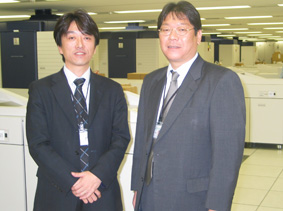 The massive task of producing so many statements in a time critical period led JAIS to evaluate a range of printing options before deciding on the iGen3 in January. According to Koji Onishi, manager, Printing Services Group (pictured left with Toshihiro Wakimoto, general manager, Printing Services JAIS), the decision to use networked iGen3s has been vindicated by the quality and dependability of the process. To date the marathon 80-hour endurance runs have gone off without a hitch. He maintains the image quality of the iGen3 is close to that of offset printing and "far outstrips other models." Already the company is fielding inquiries from other businesses to commercially print other promotional transaction documents.
JAIS parent company Sumitomo Mitsui Card is the largest credit card company in Japan with more than 13 million members. It introduced the concept of one-to-one, full colour marketing to eliminate the need to include separate direct mail items in its communications with cardholders. By including highly personalised information on the statement itself advertisers are assured their message will be read and not thrown away. Sumitomo also sees the process as an opportunity to enhance its relationship with cardholders.
Fuji Xerox hosts Platinum Partners
The JAIS site visit was the highlight of a jam-packed week of technology visits to the core of Fuji Xerox's R&D facilities in Japan. The Australians industry professionals on the trip came from such high profile companies as HPA, Security Mail, Salmat and Leigh Marden. We were given access to sensitive future-oriented technologies that will form the basis of Fuji Xerox's communicative technologies in years to come.
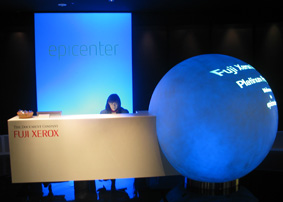 The visit began at the Fuji Xerox Epicenter in Tokyo, a customer resource centre based on the pioneering work done in Sydney at the Australian Technology Park. One of four (Sydney, Shanghai and Singapore) the Tokyo Epicenter is designed so that customers can replicate their work environment inside the high-tech surroundings while accessing the latest developments from Fuji Xerox.
At the secure Nakai research site we were introduced to the latest in remote collaboration technologies, which will change the way we work in the future. Major advances in Natural Language Technology promise a 'virtual' one-world language that can translate documents with remarkable accuracy and consistency. Other research teams are working on versions of electronic paper, holographic storage and face recognition technology. The 'pure science' approach of the researchers gives an indication of the depth and scope of the FX commitment to the industry's future.
Last stop before JAIS took us to the Ebina Campus, the powerhouse of FX production where we saw the immediate future models and technologies due to impact on the industry over the next year or so. As to what they are? Readers will have to wait for details as entry to the Campus was under a strict non-disclosure agreement. However I can assure you that in the competitive world of high-tech manufacturing Fuji Xerox has no shortage of innovations coming down the pike.


 The massive task of producing so many statements in a time critical period led JAIS to evaluate a range of printing options before deciding on the iGen3 in January. According to Koji Onishi, manager, Printing Services Group (pictured left with Toshihiro Wakimoto, general manager, Printing Services JAIS), the decision to use networked iGen3s has been vindicated by the quality and dependability of the process. To date the marathon 80-hour endurance runs have gone off without a hitch. He maintains the image quality of the iGen3 is close to that of offset printing and "far outstrips other models." Already the company is fielding inquiries from other businesses to commercially print other promotional transaction documents.
  The visit began at the Fuji Xerox Epicenter in Tokyo, a customer resource centre based on the pioneering work done in Sydney at the Australian Technology Park. One of four (Sydney, Shanghai and Singapore) the Tokyo Epicenter is designed so that customers can replicate their work environment inside the high-tech surroundings while accessing the latest developments from Fuji Xerox.