Pulp friction: why Australia needs new mills - news commentary by Andy McCourt
Woodpulp is the main ingredient in most printing, writing and packaging boards and papers. Other inputs into papermaking include recycled fiber, cotton and rag linters, straw, bagasse, Kenaf (an hibiscus-like plant) and Hemp. However, woodpulp and recycled fiber constitute an increasing amount of the world's papermaking raw materials.
 The first announcement, in October, came from forest giant Gunns, following initial results of a continuing feasibility study by renowned Finnish forestry specialists Jaakko Poyry. This is for a world-class pulp mill situated in Tasmania. By any standards, it will be huge. Estimates are that between 700,000 and 1.5 million tonnes of dry pulp could be produced. Gunns currently exports woodchips derived controversially from native Tasmanian forests, although its plantation resources are increasing. Out of Australia's estimated 7 million tonne woodchip export business, Gunns is said to account for 70% - mostly to Japan.
Gunns CEO John Gay believes ten times the value of these woodchips can be realized, by establishing a pulp mill and exporting high quality pulp. He said: "Green chips are sold for $80 a tonne and the market value of pulp is about $800 a tonne."
Just prior to Christmas, Gunns was at the centre of a legal storm over its issuing of writs against 20 Tasmanian environmentalists, including an elected Senator, for damages of $6 million. This, despite posting a 42% increase in earnings in fiscal 2003-04.
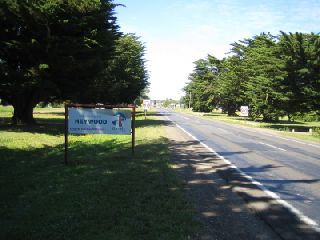
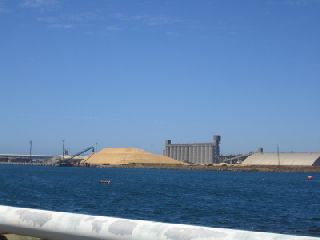
Hey hey it's Heywood.
The other pulpmill (as distinct from paper mill), project announced, just before Christmas, is the Heywood Mill project in South-Western Victoria (see pictures), 30km North of Portland. This area, known as the 'green triangle' currently exports woodchips, but all of them are derived from plantation resources.
The Queensland-based Infrastructure Project Group (IPG) is behind Heywood, and also the fledgling Swanbank paper mill near Ipswich. Forestry management concern Timbercorp has backed Heywood and will supply feedstock from its many growers, using its innovative in-field chipping system.
The $400 million project will produce around 350,000 tonnes of dry pulp per annum from 750,000 tonnes of feedstock. Construction and commissioning is due for completion in 2006/7.
IPG director Sam Winston Smith commented: “We believe that the project must have the wholesome support of the local community. The pulp and paper industry is a demanding environment and IPG recognizes the importance of engaging the community to ensure all possible impacts are identified and dealt with in open consultation.”
Sweden loses two-thirds of its forest.
On the weekend of January 8/9, fierce storms swept Northern Europe and Scandinavia, wreaking havoc on heavily forested areas. Sweden was hardest hit, with an estimated 60-70 million cubic metres of timber felled overnight. This is equivalent to about four years of normal felling. Financial losses could be as high as $5 billion. Baltic states Estonia and Latvia were also badly affected. The felled wood, if not collected very quickly, will either rot or be attacked by insects according to forestry experts. It is probably already unsuitable for sawlogs, and so will be sold to pulp mills for papermaking.
Stora Enso's Rait Hiepuu believes this will flood the market and bring prices down temporarily; “prices will go down everywhere because of over-supply, in particular Sweden,” he commented.
The fragility of world feedstock supply for quality pulp is highlighted by these events. The majority of demand is coming from China, formerly a non-wood papermaking country using straw, rice stalks and bagasse in highly polluting small mills. China's 200-2005 five-year plan has seen it close the small mills and switch rapidly to wood pulp and the opening of three massive pulp mills, the latest on Hainan Island and capable of 1 million tones of pulp a year.
MY CALL
Australia needs to make pulp from woodchips and not export woodchips alone. We also need to make more of our own paper, preferably but not exclusively from our own pulp. If managed correctly, the environment as well as the economy will benefit. By 2020, Australia plans to have THREE TIMES its 2000 plantation forestry coverage. These trees act as 'carbon sinks' and, although destined for felling, contribute enormously to ecosystems during their 8-15 year cycle.
 On a global scale, I would prefer to see well-managed, clean Australian pulp mills fed by plantation timber, rather than dubiously managed mills next to tropical rainforests or fed from illegally felled timber. In Russia, home of 24% of the planet's forest coverage, 70-80% of its timber is illegally felled, most of it destined for China and Japan.
The two new pulp projects for Australia are welcome news but there is a huge difference in approach between IPG and Gunns. Whilst IPG has adopted a consultative, all-encompassing approach, favouring a TCF (Totally Chlorine Free) mill from plantation resources only, Gunns has elected for the same combative style that cost it Wesley Vale in 1990.
Frankly, I feel ashamed to live under the same democracy that has allowed civil law to be used vexatiously against freedom of speech, as has Gunns with its diabolical writ against the 20 Tasmanian environmentalists. If it's a stunt, it's in poor taste. Gunns will also not guarantee that 100% of its feedstock will come from plantation trees and this is bad news for the already ravaged Tasmanian old-growth forests. Thirdly, Gunns has not committed to a TCF mill, with an ECF (Elemental Chorline Free) mentioned. We don't need Dioxin in any shape or form.
Gunns could learn a lot about policy and public relations from IPG. A world-class eco-friendly pulp mill in Tasmania would be fantastic for the state and the nation, but what example would we set to Brazil, Indonesia, Russia and China if it went ahead the way it is currently presented?
One of the main reasons our book printers find it hard to compete with offshore print is the cost of pulp and paper. Anything printed here has to comply to the highest standards. FSC (Forest Stewardship Certification) is becoming more prevalent. The world's largest magazine printer, Quad/Graphics, has recently achieved FSC for all pages it prints, offering publishers and readers the secure knowledge that the publications are printed on paper derived from healthy, renewable and well-managed resources.
Contrast this to the flood of books gushing into Australia and other countries, printed on who knows what, from who knows where, and containing who knows what chemicals? No one is checking.
Let's all get behind the two proposed pulp mills and Ipswich paper mill, but making sure they are established in a way that we can be environmentally proud of. The overall printing, packaging and graphics industry will benefit.
Pics provided by Chris Riches


 The first announcement, in October, came from forest giant Gunns, following initial results of a continuing feasibility study by renowned Finnish forestry specialists Jaakko Poyry. This is for a world-class pulp mill situated in Tasmania. By any standards, it will be huge. Estimates are that between 700,000 and 1.5 million tonnes of dry pulp could be produced. Gunns currently exports woodchips derived controversially from native Tasmanian forests, although its plantation resources are increasing. Out of Australia's estimated 7 million tonne woodchip export business, Gunns is said to account for 70% - mostly to Japan.
 On a global scale, I would prefer to see well-managed, clean Australian pulp mills fed by plantation timber, rather than dubiously managed mills next to tropical rainforests or fed from illegally felled timber. In Russia, home of 24% of the planet's forest coverage, 70-80% of its timber is illegally felled, most of it destined for China and Japan.