Raising the Quality Threshold
Screening Technology – Agfa White Paper
 The transition from computer-to-film to computer-to-plate raised the quality bar in plate imaging significantly. Eliminating the film and imaging directly to plate gave pressmen cleaner, more precise dots to work with. It increased productivity in prepress and reduced make ready on press. But the best was yet to come. CtP, by its very nature, enables the application of other image-improvement technologies, such as screening.
Four-color process printing has always been a compromise.
While it gave us what appeared to be realistic color, it came with a variety of handicaps-a limited spectrum, dot distortions and screen interferences, to name a few.
Attempts to purge the process of these flaws have been going on since long before digital technology ever arrived on the desktop. For example, better film emulsions and plate coatings improved dot retention. But not even the most perfect celluloid dot in the tightest vacuum seal has ever been able to reach its aluminum host completely unscathed. Even when imagesetters came along using lasers to precisely etch the dot onto film, the other variables remained in play.
Hi-fi color promised us a vibrant, more colourful world.
With six instead of four colours, it would widen the colour spectrum dramatically-and it did. But its worst problem was juggling the screen angles to accommodate two more colours. Most clients were unwilling to pay more for all the extra effort it required.
Stochastic screening was the next technology promising to revolutionize offset printing.
Instead of amplitude modulation (AM), it used frequency modulation (FM).
AM screening places dots evenly in a grid. The dots vary in size depending on the tone value or density of the image.
FM technology does not use a grid. Instead, it varies the placement of microdots, and increases the frequency or number according to image density. Like paint on canvas, it brushes more or fewer microdots where needed. The resulting image prints like a photograph rather than a halftone.
The problem with stochastic screening in a film workflow was the film. Because FM technology uses microdots, as small as 14 microns, holding dots in low-density areas from film to plate, and then on press, was doable but difficult. Only printerswilling to take the needed time and impose strict quality procedures were successful.
Sublima Screening Technology
CtP: The Enabling Technology
Computer-to-plate changed all that. Imaging directly to plate frees the press from many of the limitations of the four-color process. It eliminates most dot distortions and can more accurately compensate for dot-gain on press. Because of this, it is easier to print with higher screen rulings. And with film no longer an obstacle, printers are now enjoying the benefits of stochastic screening.
The Benefits of FM Screening
There are many. Let's look at quality first. The method of microdot disbursement closely resembles that of a composite or a continuous-tone print. So images look like photographs. Because there is no true screen, there is no need for screen angles, and therefore no moiré or aliasing effects to worry about.
With no screen angles, hi-fi-color printing, such as Pantone's Hexachrome, which adds a green and orange to the CMYK set, is possible, thereby widening the color spectrum. Six-color stochastic printing can reproduce much of the RGB gamut.
Halftone proofing, which printers employ mostly to check for moiré, is no longer necessary. Inkjet contract proofs are all that is needed.
Because stochastic technology uses fine microdots-from 14 to 31µm - it can capture minute details in the highlight and shadow areas that are not possible with halftone screens. With AM screening even nearly doubling line-screen resolution, to say 275 lpi, highlight and shadows become posterized, as the small dots either plug or get lost on press. And compressing the tonal range to correct for this yields muddy results.
The Benefits of AM Screening
In the midtones in particular, AM screening is very predictable and prints with equally smooth gradations as FM. And it is actually better with flat tints than FM, which can cause graininess or visual noise.
In addition, AM behaves much better on press than stochastic screening. Because the FM microdots are all the same size, it can be difficult to make on-press adjustments to color. With AM press operators can even make adjustments to maintain gray balance throughout the press run; this is not possible with stochastic screening. The printing press, after all, is the final variable. This is the reason why many printers are reluctant to change screening technologies.
 Regardless of technology - visible light or thermal- CtP often delivers details on plate that cannot be held on press. In this example, a 10.6 micron line is imaged nicely on plate, but in order to hold the fine line on press, the shadow detail is lost.
Screen Imperfections
A moiré effect is created by superimposing one geometric pattern on a similar or identical pattern that is slightly out of alignment.
Colour Moiré
Moiré patterns caused by misaligned screen angles.
Subject Moiré
When an image itself has a pattern-a brick wall, tiled roof, or a checkered jacket-it can also interfere with screen angles.
Aliasing
Aliasing creates a very similar effect to moiré. However, it occurs when a high-frequency image is resampled to a very low frequency.
Combining the Best of Both
If you take the benefits of FM screening technology-the absence of screen interferences, continuous-tone quality, the ability to reproduce the finest details- and combine it with excellent performance on press, you would have the perfect screening solution.
Agfa offers a screening technology that has captured the benefits of both AM and FM screening. It is called :Sublima.
This patented technology combines both screening techniques into a single solution.
It works like this. In the midtones, :Sublima uses Agfa Balanced Screening (:ABS) for clear, accurate reproduction. In difficult highlights and shadows, :Sublima uses FM technology to reproduce the subtle tones and every shadow detail. But the software doesn't simply switch from one screen to another. It uses patented technology to determine the precise changepoint between AM and FM screening and smoothly transition from one to the other. And although the FM areas use smaller dots controlled in FM mode, they are still aligned using the screen angles established by :ABS. The end result is an entirely new species of modulation. :Sublima generates line-screen equivalents of 210, 240, 280 and 340 lpi.
There is more. :Sublima software takes into account all possible variables. It calculates the smallest dot size that a plate can hold on specific presses. Built-in calibration curves automatically compensate for differences in dot gain. It can hold a 1-99 percent tonal range throughout long press runs.
Among the technology's greatest advantages is its performance in prepress and on press. At the highest screen ruling-340 lpi-it RIPs at only 2400dpi resolution. The same 340 lpi screen behaves on press no differently than a 150-lpi screen-including ink-water balance and plate performance. :Sublima requires no extra effort yet delivers a new level of quality with computer-to-plate.
The New Level
The benefits of printing at 340 lpi are obvious.
With no apparent screen, images look like photographs. Because :Sublima takes press characteristics into account, highlight details do not disappear and shadows do not plug up, so every detail gets printed.
Fine lines, even delicate typefaces print like solids using four-color process.
Solid and process tints reproduce like translucent paint, with no coarseness or trace of color mix. This happens because :Sublima applies ABS algorithms for perfectly smooth transitions. Degradees and vignettes print as if they were air brushed directly on the printed sheet for the same reason. Even the stochastic microdots, because they align along :ABS
angles, print with no hint of irregularity.
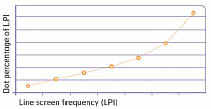 :Sublima XM (Cross Modulation) Technique.
Within a photograph, you cannot see the transition from an AM to FM screening implementation. However, on a single plate, within a vignette, and with a magnifier, you can see the :Sublima screen structure. Since :Sublima works with the smallest printable dot, the "changepoint" as a percentage of the line screen ruling increases as the frequency increases. As you can see below, the same size small dot that measures 1% at 120 lpi, measures 0.5% at 85 lpi, and 2% at 170 lpi.
:Sublima's patented algorithms are also the reason flesh tones are perfectly smooth and color accurate.
Because holding the tiniest microdot on press is easy for :Sublima, enlarging or reducing images have no effect on quality or the ability to sustain details. This also widens the variety of papers that you can use at high line rulings-from high-gloss coated stocks to translucent vellums and newsprint.
:Sublima was clearly designed with printer, designer and consumer in mind, substantially raising the quality threshold for all printed materials.
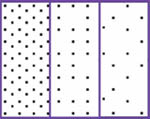 :Sublima XM (Cross Modulation) Once :Sublima reaches the smallest reproducible dot for a specific press, it no longer makes the dots smaller. Instead, it uses a patented method to "take-out" dots. Even though the dots at the highlights may appear to be random, you will notice the dots continue to align along defined :ABS (Agfa Balanced Screening) angles.


 The transition from computer-to-film to computer-to-plate raised the quality bar in plate imaging significantly. Eliminating the film and imaging directly to plate gave pressmen cleaner, more precise dots to work with. It increased productivity in prepress and reduced make ready on press. But the best was yet to come. CtP, by its very nature, enables the application of other image-improvement technologies, such as screening.
 Regardless of technology - visible light or thermal- CtP often delivers details on plate that cannot be held on press. In this example, a 10.6 micron line is imaged nicely on plate, but in order to hold the fine line on press, the shadow detail is lost.
 :Sublima XM (Cross Modulation) Technique.
 :Sublima XM (Cross Modulation) Once :Sublima reaches the smallest reproducible dot for a specific press, it no longer makes the dots smaller. Instead, it uses a patented method to "take-out" dots. Even though the dots at the highlights may appear to be random, you will notice the dots continue to align along defined :ABS (Agfa Balanced Screening) angles.