


The news that Electrolux is closing its Orange, NSW factory, the last refrigerator manufacturing plant in Australia, (the country that invented modern refrigeration in 1854 by James Harrison in Geelong), is yet another apparent nail in manufacturing’s coffin and testimony to decades of poor government policy, neglect, industrial short-sightedness and global pressures.
Ford has also announced it will cease manufacturing cars in Australia by 2017. Food and clothing are not immune from the trend, with the well-publicised exit from domestic manufacturing by Pacific Brands; custodians of Bond’s, King Gee, Berlei and Hard Yakka. Kraft closed 2 biscuit factories in Melbourne in 2011 and shifted production to China. Tetra Pak now prints all of its ‘brik’ cartons in Thailand: - the list goes on. How much print follows the exits of these manufacturers is anyone’s guess.
Of course we must be an importing nation if we are to be a successful exporting one and enjoy a balance of trade in our favour. With metals, coal, oil and natural gas accounting for around 54% of our exports (source: ABS); around 14% for Rural production and a steadily growing 20% for Services it does not leave a lot for Manufacturing and other merchandise.
The overall trend is for Resources and Services to be increasing in exports and Rural, Manufacturing and other merchandise to be decreasing. By 1960, Manufacturing accounted for 29% of Australian GDP; today it is well below 10% and the bar charts continue to shrink.
Hope amidst the gloom
Amidst this gloomy scenario for manufacturing, there is one category that can hold its head up as retaining relevance, employment, innovation and diversity, despite taking a battering along with other manufacturing sectors. Call me a madman but I say it is Printing and all of its allied processes.
The Australian Printing industry today is making sales of approximately $7.5 billion before value added. The true figure could be up to 30% higher than this as so much ‘printing’ goes unreported as part of other processes or performed in IT environments. This figure never fails to dismay the sceptics because they relate print to newspapers, magazines and books – things that they see and touch in their own lives and are information media - based. In any city, we are never more than a metre or so away from something printed.
The label on the bottle, the sign by the roadside, the logo on the shirt, the circuitry inside the smartphone, the barcode on the product, the use-by date on the food: print is everywhere. Approximately 5,800 businesses employ around 45,000 directly in printing (about the same as the car industry). When all of the ‘value-add’ is tacked on, such as pulp and paper manufacturing, converting and publishing, probably 110,000 jobs depend on printing and packaging is some way and the value-added industry is worth over $32 billion to the Australian economy.
However, like all other manufacturing, the trend in recent years has been in decline. The GFC and Private Equity shenanigans have not helped but despite these and the Online/Mobile information juggernaut, printing continues to be a viable and progressive industry. Growth sectors such as outdoor signage, point-of-purchase, vehicle graphic wrapping, labels and emerging 3D and electronics printing offer identifiable future pathways. Adding services such as direct mail, fulfillment, re-purposing information to tablet and mobile devices, website development for e-commerce, digital asset management and creative consultancy provide bountiful prospects for those not content to stand still.
It’s a good time to take stock and re-think what ‘the industry’ really comprises and what it should look like in 2020. We need to re-manufacture Australia’s third largest manufacturing industry, with ‘what if…?’ engraved in our minds.
3D printing – an opportunity waiting to be missed?
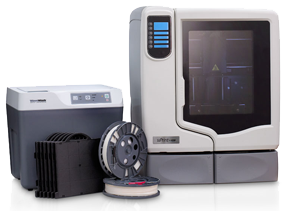
- Stratasys uPrint SE industrial 3D printer
Take 3D printing as an example. Those using it commercially to manufacture prototypes and short-run parts prefer to call it ‘additive manufacturing’ because they are presumably ashamed to be associated with ‘printing.’ I’ve got news for those folks – you’re stuck with 3D Printing; it’s already in the lexicon. 3D Printing evolved from inkjet and is on a near-vertical trajectory. Boeing is now using it to make may aircraft parts and there is a nascent trend in the USA for ‘contract 3D printing’ outlets where CAD files (such as Autodesk) are sent in, pre-flighted much in the same way as PDFs are pre-flighted, and printed in short runs or one-offs. UPS has rolled out a handful of 3D Printing service centres using the Stratasys uPrint SE industrial printer.
Online 3D prining is just becoming available, mostly for jewelry, novelties and prototypes. One, www.shapeways.com offers a cloud-based ‘2D to 3D’ file conversion so customers can create 3D objects from their own 2D designs. Another: www.3dquickparts.com.au is more industrial part focused and available in Melbourne and Sydney.
Where are Australia and New Zealand printers with 3D technology? You know file preparation and inkjet – why not offer 3D services too? Here is a link to an excellent article “Can 3D Printing Save Australian Manufacturing?”
Printers have one big advantage over other manufacturers in that the concept of making ‘just one’ or a few, at a profit, has been around since 1993. The Textile, Clothing and Footware sector for example struggled with this idea and is only just discovering digitally-printed textiles and short-run manufacturing. All it takes is a bit of lateral thinking and the courage to go beyond ‘marks on paper.’
Printed electronics is another emerging field utilizing digital inkjet technology. At drupa 2012 a whole seminar was devoted to printed electronics and other ‘Functional Printing’ where the printed product acts as a device or interacts with the user.
Core traditional printed products will of course continue to be used but in smaller numbers and with diminishing returns. The profit opportunities are in ‘Printing that feels like a Service.’ Someone somewhere wants just three copies of their Powerpoint presentation slides, for example. Someone somewhere wants 250 good quality labels for their home-made jam; a real estate agent wants 100 off-the-plan prospectuses by tomorrow morning – that kind of thing.
It’s a hybrid world and printers who can re-manufacture their businesses by taking onboard new and diversified methods, creating whole new divisions that, while using core skills and technology, bear no resemblance to a ‘normal’ printshop – it is these printers who will do well and prosper. Tablet/xPad/Mobile publishing services and Apps would appear to be prime candidates.
Our re-manufactured industry should look a whole lot different by 2020. If it doesn’t, it might not be there.