Stories sought on old government printing office
An anecdotal history research project on the old Ultimo NSW Government Printing Office needs input from people who may have worked or been involved with the Office from 1959 to 1989.
The project is being undertaken by PhD researcher Jesse Adams Stein from the School of Design at the University of Technology Sydney.
Printing Industries has been asked to assist with the project and will add the completed written research paper to its print history collection.
According to national communication and technical services manager for the Printing Industries, Joe Kowalewski, the project covers a period of dramatic technological change in the printing industry. “During the 40 year span the industry completely restructured and transformed the work culture of printing, including the loss of many trades.
“Skilled trades people had to retrain and learn to use word processors and computers. Often work environments shifted from factory-like spaces to those more closely resembling offices.
“It was period of significant cultural change that ushered in a new era of technological and business innovation and challenge, both of which continue to be hallmarks of the industry today,” he says
Stein, a lecturer and tutor in art history and design history, chose the printing office as part of her doctorate studies because of her passion for the Ultimo area (where she lives) and her interest in documenting the history of the office focussing on “objects and technologies” – issues and stories relating to machines, printed matter, material culture and technological change.
“I'm interested in workers' physical and psychological relationships with their equipment - in other words, human-machine interaction,” she said.
“In what ways did people feel connected to their machinery? In what ways did they feel pride and satisfaction in the quality of their work? In what ways were printing work-roles still perceived as 'gendered' (men's work / women's work) or had those old divisions broken down?”
Stein says she was interested in the consequences of worker retraining - especially in relation to the shift from letterpress to litho and the shift from hot metal typesetting to 'cold composition' in its various stages.
“I'd like to hear about what the Printing Office was like as a working environment. How much did this workspace change over time, as newer technologies were brought in? Was it a high stress environment? Was it very social? What was enjoyable about the work? Was it an efficient printing house?”
Stein says she was keen to speak to anyone who worked at the NSW Government Printing Office (pictured) - all trades and occupations, male and female, all ages.
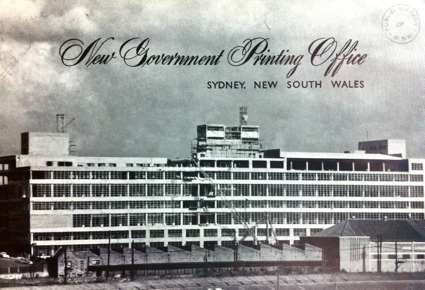
“Although my emphasis is on design and material culture, I'm just keen to hear people's recollections of their working life at the Printing Office, regardless of whether or not they had to deal directly with the consequences of technological change. Of course - everyone who worked there at the time of its closure in 1989 will have a story to tell about the sudden abolition of the Printing Office - I hope to hear many different points of view.”
Stein plans to hold informal, recorded interviews at a time and place convenient for participants. Interviews could be between 30 minutes to a maximum two hours.
Kowalewski notes that the completion of Stein’s project is expected to take about two years.
“The emergence of this project comes at a time where there appears to be a resurgence of interest in print industry history. We will shortly be making announcement in relation to some of these developments,” he said.
Stein can be contacted on 0425 141 295 or e-mail: jesse.stein@uts.edu.au


