


The dream of processless CTP becomes a reality
 After its worldwide debut at DRUPA last May, Agfa’s revolutionary chemical free plate :Azura is already gaining keen interest here in Australia. In a recent article in The Bulletin Print21Online we explained in the form of a technical primer how Agfa’s revolutionary :Azura chemical free plate works.
www.print21.com.au/index.cfm?pageid=feature&id=12&archive=243.
Over the past few months Agfa buoyed with success have announced further enhancements to the system. Agfa’s early customers, (in the main European based), are delighted with the simplicity and quality that :Azura gives. So naturally Agfa was delighted to know that the readers of the influential Deutscher Drucker voted :Azura as the most innovative product at Drupa 2004 in the pre-press category.
This prestigious award is formal recognition of what Agfa’s launch customers are quickly discovering, namely that :Azura is simply the best product available for those printers looking for the ultimate in CtP simplicity, performance and reliability.
:Azura is now globally recognised as the most advanced product in the new category of processless or “chemical free” plates and many of Agfa’s competitors remain a long way behind their advanced commercial status. The Deutscher Drucker award rewards Agfa's technology as well as its ambition to be first and best in the field of chemistry-free/processless.
Quite clearly, there are a large number of printers that have been waiting for a product like :Azura, either as their first CtP system or to replace an older CtP system.
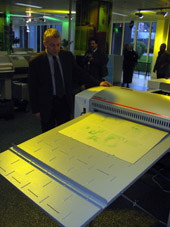
 Agfa’s Worldwide Product Manager for Thermal CTP Systems, Jack Wolber (pictured) visited Australia last month with some new announcements relating to the :Azura range. Wolber described Agfa’s CTP R&D innovation as a “freight train." He pointed out that while many of Agfa’s competitors now view CTP as a mature technology, Agfa continues to invest and innovate being almost alone in bringing new CTP technologies to market.
“:Azura is testament to this” said Wolber. “Whilst others talk of the dream of processless CTP, we are already shipping commercial product. It gives us an enormous lead on the others”
Azura when announced at DRUPA was launched as a 4up solution based on Agfa’s :Acento thermal platesetter. “Most of the launch customers were 4up because that’s where the initial interest was generated,” said Agfa’s Regional Marketing Manager Garry Muratore.
“We continually received requests from customers in the eight-up segment looking for chemical free solutions so the Xcalibur 45 has now been certified for :Azura use”
It is for that reason Muratore and his team at Agfa invited Wolber to Australia to brief key accounts on Agfa’s new CTP innovation which include the certification of :Azura on the GLV based Xcalibur 45.
“The XC45 is a perfect platform for chemical free plate production,” said Wolber. “It’s well known that any processless or chemical free technology requires a lot more energy than conventional CTP to expose.
"The XC45 with its state of the art optics/laser combination means that we don’t have to significantly sacrifice production. The Xcalibur 45e which exposes the :Azura plate can produce 12 full size plates per hour as against 15 conventionally processed plates”
“And being GLV-based the system can also expose high resolution cross modulation screening as standard without the need to utilise older Square Spot imaging technology."
 :“Although :Azura is still a relatively new product it is based on proven ThermoFuse technology” said Muratore. (pictured) “Since DRUPA 2000 we have been selling ThermoLite as on on press application”
:Azura comes from the same ThermoFuse family as ThermoLite and is clearly one of the most significant new Agfa products for some time. “We have high expectations of the commercial success that we can achieve with :Azura and the opportunity to launch into the 8up market only galvanizes our resolve,” said Muratore.
To support Agfa’s new ThermoFuse technology, Agfa has produced an excellent whitepaper, which we produce with permission in its entirety.
Computer to Plate: How Digital?
 Removing the variables of chemical processing
digital plate imaging such as it is used in current computer-to-plate systems forms a latent image on the plate using the heat or the light of a laser. This image is latent, which means it is not yet ready for printing. It may or may not be clearly visible on the plate. Chemical development transforms the latent image into a durable printing image such as it is needed for offset printing.
Although chemical plate development is an automated and tightly controlled process, it remains an essentially analogue step. The affect of the chemistry on the image varies depending on the temperature and exhaustion of the chemicals, the speed at which the plate travels through the processing unit, the thoroughness with which the plate is rinsed and treated with preservative gum and optionally, pre-heat or pre-wash steps.
Chemical processing is analogue rather than truly digital. No matter how tightly you control it, it is only accurate within tolerances.
How does ThermoFuse work?
In conventional CtP systems, the heat or light from the laser hits the sensitised layers of the plate and forms a latent image. This may or may not be visible, but it is not physically durable. Next, the plate is developed. Plate development is the chemical process that is needed after imaging to make the latent image stable and durable.
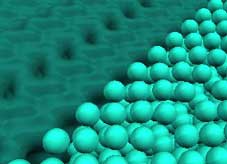 ThermoFuse imaging, unlike conventional CtP, does not rely on adapted analogue processes. Using the high power of today’s lasers, ultra fine thermoplastic particles are melted and fused together to create a durable image on the aluminium plate substrate in one single, digital step. This image does not need development. It is ready immediately after imaging. No subsequent steps can alter it in any way. The image that is formed on the plate is precisely the image that will be printed on press. In other words, ThermoFuse is 100% binary.
The only thing left to do after imaging is to remove unused latex in the non-image areas in a cleanout step. ThermoFuse uses a single-layer coating, and immediately under the latex is the aluminium printing surface.
The benefits of ThermoFuse
A plate made with ThermoFuse imaging does not require chemical processing. Although this is not true processless CtP, the immediate benefits are plain to see. It eliminates variables and provides a non-ablative aluminium plate with excellent press behaviour.
 After its worldwide debut at DRUPA last May, Agfa’s revolutionary chemical free plate :Azura is already gaining keen interest here in Australia. In a recent article in The Bulletin Print21Online we explained in the form of a technical primer how Agfa’s revolutionary :Azura chemical free plate works.
  Agfa’s Worldwide Product Manager for Thermal CTP Systems, Jack Wolber (pictured) visited Australia last month with some new announcements relating to the :Azura range. Wolber described Agfa’s CTP R&D innovation as a “freight train." He pointed out that while many of Agfa’s competitors now view CTP as a mature technology, Agfa continues to invest and innovate being almost alone in bringing new CTP technologies to market.
  :“Although :Azura is still a relatively new product it is based on proven ThermoFuse technology” said Muratore. (pictured) “Since DRUPA 2000 we have been selling ThermoLite as on on press application”
  ThermoFuse imaging, unlike conventional CtP, does not rely on adapted analogue processes. Using the high power of today’s lasers, ultra fine thermoplastic particles are melted and fused together to create a durable image on the aluminium plate substrate in one single, digital step. This image does not need development. It is ready immediately after imaging. No subsequent steps can alter it in any way. The image that is formed on the plate is precisely the image that will be printed on press. In other words, ThermoFuse is 100% binary.
- 100% binary
- Aluminium printing surface
- Non ablative
- Technology available today
- Real step towards processless CtP
- Easy to use
- Visible printing image
- Eliminates the variables of conventional CtP
- Cleaning/preservative gum but no developer
- Compact
- Environmental
ThermoFuse has been conceived with ecology in mind. The plates have very thin single-layer coatings of aqueous solutions. Their thermoplastic (latex) particles are chemically inert. The pH of :Azura cleaning gum, for instance, is close to that of tap water. Gum contains no alkaline or corrosive agents or solvents.
ThermoFuse is also non-ablative. As with all thermal CtP systems, some unwanted ablation occurs, but it is at such a low level that there is no risk to the operator or the environment.
Proven technology
ThermoFuse technology has been around since 2000, when Agfa first introduced the :ThermoLite plate for on-press imaging. :Thermolite is in use on over 100 direct imaging presses and is well accepted by the market. :Azura was introduced at Drupa 2004. It is imaged in a thermal platesetter at 830 nm with an online gumming step to clean out non-image areas.
Growth path to true process free
ThermoFuse is a broad technology platform. Currently, two types of plate are available, but the technology has potential for many more that share the benefits of simplicity, predictability and environmental friendliness. ThermoFuse is the most likely direction for a true processless CtP system in the future.