


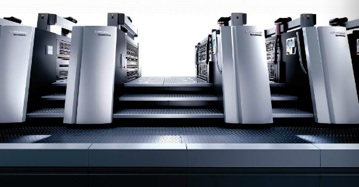
 The ‘boom’ of digital print is deafening while sheetfed offset is meekly considered a ‘bust’ – but is it necessarily so? Pira International’s Future of Global Printing Markets says that of the world’s 49,152 billion A4 pages printed in 2012, offset accounted for 76 percent. Total digital print volume clicked up just 2.1 percent. Dollar share is much higher at 12.6 percent thanks to better pricing per sheet but nevertheless, digital printing is still a minnow in overall global printing output. Alison Stieven-Taylor bravely presents some inconvenient truths.
 The ‘boom’ of digital print is deafening while sheetfed offset is meekly considered a ‘bust’ – but is it necessarily so? Pira International’s Future of Global Printing Markets says that of the world’s 49,152 billion A4 pages printed in 2012, offset accounted for 76 percent. Total digital print volume clicked up just 2.1 percent. Dollar share is much higher at 12.6 percent thanks to better pricing per sheet but nevertheless, digital printing is still a minnow in overall global printing output. Alison Stieven-Taylor bravely presents some inconvenient truths.
In the years 2008-2011 the global A4 print market dropped 2.1 percent – that’s half a percent a year on average. Certainly within that figure there is a mix of fortunes across territories, but globally the volume of print being produced is relatively static. That isn’t to say the market for print in Australia hasn’t shifted because we all know it has. But the attrition of print companies and the resulting consolidation of the sector over the past few years have now slowed. Overall, the market appears to have settled into the new paradigm, although Heidelberg’s Richard Timson thinks there’s still fat to trim in the Melbourne market and we will see further consolidation before it plateaus.
While Smithers Pira detailed report (available from www.smitherspira.com), claims the digital print sector is marked for strong growth in the future, it is still a long way behind traditional printing methods, as research proves. That fact must confuse the digital print evangelists who are certain that if there was life before digital it is surely now nothing more than dust on the pages of history, albeit analogue printed pages.
There is no doubt digital technology has revolutionised the way society operates. In the printing sector, digital has made considerable impact in terms of the number of print companies that now use digital presses and employ digital production processes. But talk to the sheetfed offset suppliers and they shrug off any suggestions that offset is dead. They see digital printing as a complemen-tary technology and many of their customers are operating both platforms.
A mature but huge market
The major printing press suppliers in the offset sector have undoubtedly taken a hit since the GFC in 2008, and the reasons for this are complex; it’s not just a matter of new technologies supplanting old, nor economic pressures. Australia and New Zealand are mature markets and the opportunity for continuous growth is slim. While digital press sales are purportedly soaring, that market will hit saturation point too. Perhaps the lower cost to entry with digital will keep sales turning over, but there’s not a lot of new ground to sow and the digital guys may well face the same issues that offset is now presented with – too many suppliers in a reduced buyers market.
The A3 sheetfed offset sector appears to have stalled if the sales being made by the big five – Heidelberg, manroland, KBA, Komori and Ryobi – are any indication. All report new installations, predominantly in the A1, but also in the A2+ sectors, with manroland confirming the A3 market is not even on its radar.
Where opportunities lie for these suppliers is in commercial and packaging with print companies updating their equipment and replacing several older presses with a single new, highly specified press.
“The new presses are really doubling the throughput,” says Steve Dunwell, managing director of manroland Australia; emphasising that utilisation is a key motivator for his customers. “The market is buying equipment because they need to be more productive and benefit from the speed and automation that the new presses have.” So, it’s not about increasing, but rather making the best use of existing capacity by producing work faster and more efficiently thereby increasing margins.
Offset finds its voice
Others echo his words. “We’ve put in a number of presses that have replaced older equipment. Two or three presses come out and a single new press goes in,” says Timson over at Heidelberg. “Generally, customers’ workloads are reasonable. All the machines we’ve put in have led to improving capabilities and people have managed to fill them up. For those who are putting in a digital machine it tends to be complementary, to give them more tentacles in the market.”
Bernard Cheong of Ryobi distributor Cyber, says: “The market is still very patchy, but what we know is that the productive and well organised companies are keeping themselves very busy and progressing rapidly. Continuous investment and upgrading is required to stay ahead of the game. The trend is now more capability driven, and less capacity driven. Once inefficiencies are addressed and improved, offset is still a very lucrative business.”
While offset press suppliers are largely focused on the packaging segment in Australia, it’s a small pool to swim in. “The packaging market hasn’t changed in terms of the players,” says Timson, claiming the barriers to entry influence a lack of new entrants. “It isn’t just a matter of installing a new press, but all the ancillary equipment required to produce quality packaging and the business savvy to go up against the bigger players in the market.”
Komori’s Carsten Wendler believes the packaging market: “…will always be strong because people have to eat and drink regardless of what’s happening to the economy.” That’s true, although Australian packaging printers are competing not only within the domestic market, but offshore also. While the sector is holding its own, it’s hardly exper-iencing a period of growth in volume.
Asked if the packaging segment can accommodate all the suppliers vying for business, Wendler is adamant. “No definitely not. The Germans have to consolidate as the suppliers in Japan have.” Wendler says Komori has diversified and is strong. “We had a massive restructure two years ago. We’ve gained efficiencies and streamlined. We’re financially solid and are happy with our numbers.”
Playing to strengths
Dunwell says manroland plays to its strengths, and isn’t overburdened by overheads or unrealistic expectations. “We don’t try to be all things to all people. We concentrate on existing customers. In sheetfed offset our strength is in the packaging market in particular, but we have some very good commercial print customers as well.”
KBA is also “strong” in packaging, so much so that it’s somewhat typecast, says KBA Australasia director Dave Lewis. “KBA Germany’s strategy is to go after the specialty packaging markets, but our presses are suitable to commercial work also.”
Lewis says he’s: “…accepting of the new reality of fewer press sales. It’s a tough market, but I’m cautiously optimistic. We have a good reputation in packaging and are a subsidiary of KBA, not an agency. We are streamlined, and have never grown too big.” KBA has been in operation in Australia for nearly 14 years. “We’ve never had to downsize and at the moment we are looking for technicians to grow service.”
In recent times KBA has installed a Rapida 106-10 colour perfector into a commercial print business in Perth, a machine that has replaced three other presses. A new Rapida 106-6 colour with double coater has gone into a packaging printer in Brisbane. Both of these machines are very highly spec’d and, according to Lewis, are performing extremely well.
Overseas, manroland sheetfed, which was saved from the brink by Langley Holdings in 2012, is doing brisk business having sold 200 printing units from March to May this year. “These sales are across lots of different countries, not just China and that’s a good sign,” says Dunwell. “At the moment manroland Sheetfed is at capacity in the factory.”
In ANZ the manroland 700 series, for the A1 market, is the most popular and over the past 18 months around 30 print units have been sold and installed, equating to around five presses. The Roland 706, a six unit press with coater, is the most favoured. “And we’ve recently taken an order for a Roland 707, with seven units,” says Dunwell.
Old dogs with new tricks?
Komori’s focus in on selling specialised presses – long perfectors in particular. Its HUV technology has been a boon for the company here and inter-nationally according to Wendler who says they’ve recently written orders for new machines, although he’s not prepared to share details for now.
Cyber’s Cheong reports a total of nine new machines have been sold over the past year with seven already installed and another two to be completed in the coming months. The majority are 8-colour perfector presses for the A1 sector, but they have also sold two very large format perfectors for the packaging market. The remaining installations are in the B2 category.
Four of the presses come with Ryobi’s third generation LED-UV printing system, which Cheong says is “a game changer.” He says Ryobi is the market leader in UV applications and he is excited about the oppor-tunities the enhanced LED-UV technology presents. He claims that the vastly reduced power consumption of the third generation LED-UV makes the HUV and eco-
UV applications “almost redundant.”
In the last 12 months Heidelberg has installed a couple of A3 machines, but Timson says most of the interest is coming from commercial printers in the A1 and A2 markets where the company has installed around six large format presses, with another couple in the pipeline.
“Australia and Japan separate themselves from the rest of the Asia Pacific region by investing in high technology and paying for greater automation; people are still investing here. Everything we are putting in is going magnificently well. Put them in and watch them go,” says Timson. He’s not worried about digital encroaching on offset in the larger format markets as he doesn’t believe the technology has proven itself a worthy competitor yet.
Wendler concurs: “Digital has got a long way to go, in my opinion, before it can replace offset in total…there is definitely space for offset, absolutely, or we wouldn’t be in it we’d just close the doors now.”
A place for everything
“Digital is important and offset is still important and they both have their place,” says Dunwell. “I see them as complementary as I always have. The best printers will have digital presses and offset presses and will know which jobs run best on which platform. Packaging is still dominated by offset and will be for some time.”
In the future, an argument for technology outsmarting the market may be tabled; the more advanced a press the less likely the need to upgrade in the short term. The more automated, the less people employed. It’s not a scenario that belongs to the printing industry alone and is a plague that is sweeping traditional manufacturing centres. But while there are numerous machines in the market operating on ‘old tech,’ the push to improve efficiencies and drive profits exists, so offset suppliers clearly have room to move.