Two new engines from Océ launch digital mid-production battle.
With the pre-launch of two new machines this week, the black and white VP2110 and the colour CPS900, the company is staking out territory away from its traditional ultra-high and very-high volume market into one where up to one million copies a month is more the norm. It is squarely targeting market leader Fuji Xerox, which last week launched its iGen3 and Nuvera products into the marketplace.
 Océ describes this target market as a cross between corporate enterprises, made up of print rooms and document production centres, plus standard walk-up printing facilities and commercial printers offering full or partial digital services. World demand for machines to these markets is expected to hit nearly 40,000 units in 2004, with steady growth predicted for the coming years.
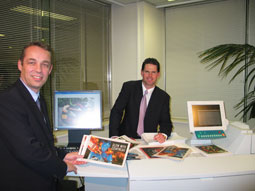
Tim Saleeba, marketing manager, digital document systems, (pictured on right with Steve Wilson, business unit director) says Océ has identified a number of key trends in the mid-production market.
“This is a market which produces from 150,000 to one million copies per month,” Saleeba says. “It involves shorter runs of more complex jobs, such as manuals with tabs, books with covers and mailing inserts. It also includes long runs of simpler jobs and familiar tasks such as straightforward copying, collating and stapling.
“There is also a growing convergence of black and white and colour as companies realise the increasing importance of colour to their corporate documents.”
The two machines previewed at the company’s St Kilda Road showroom this week will spearhead Océ’s assault. Operating at 105 impressions per minute, the Océ VP2110 is a system that the company projects will emulate the success of its highly popular Océ 3165, released in the mid-1990s.
“What makes the Océ VP2110 such an impressive machine is its delivery of outstanding productivity to the print floor through its ability to perform all functions at full engine speed,” says Saleeba. “It can RIP information and perform collating and finishing tasks at a constant print speed of 105 impressions per minute. It even has a ‘Print While RIP’ feature so that printing is not delayed until a multi-page document has been completely ripped.
In the colour market, the CPS900 throws out a broad challenge in an arena that is seeing many more competitors apart from Fuji Xerox such as HP Indigo, and newcomers Ricoh and Konica Minolta.
“The CPS900 achieves consistent colour automatically, without calibration, for printing on a wide range of media choices on sizes up to oversize A3,” Saleeba says. “This means users can rely on colour consistency for such specifics as corporate colours, logos and brand reproduction. Your jobs can be printed on machines as far apart as Melbourne and Milan, this year or next, on paper or textured card, and still achieve identical colours.”
The reproduced image is created in a single step without using a light source. The toner image of each required colour is transferred onto an intermediate drum and then onto the paper in a single pass.
Saleeba says the consistent colour performance of the Océ CPS900 is the result of trademarked Océ Colour CopyPress technology developed over years of research.
“Océ Colour CopyPress allows the complete seven-colour toner image to be ‘pressed’ onto the paper for consistent, high quality colour - with a single layer of toner fused at a lower temperature. Because it uses virtually no silicon oil, there’s no excessive surface shine, so prints come out with an offset look and feel and with no cracking of toner during folding.
“Output is achieved with a print resolution of 600 dpi which results in sharp, photo-realistic images. We consider this to be imperative for professional document production environments whether printing onto embossed, textured, or coated paper - even overhead sheets.”
“Operators can also utilise heavier media - up to 250gsm - while maintaining full engine productivity with A4, A3 and oversized papers. The machine will produce up to 1,000 oversized sheets in one run, without operator intervention. Duplexing, when required, is automatic on all media,” he says.
The Océ CPS900 operates at a constant print speed of 30 x A4 (15 A3) images per minute, no matter what the media.
Both Océ systems utilise a shorter paper path than conventional xerography systems, which the company claims virtually eliminates paper jams and results in further productivity.
The Océ VP2110 and the Océ CPS900 will have a September market release in Australia.


 Océ describes this target market as a cross between corporate enterprises, made up of print rooms and document production centres, plus standard walk-up printing facilities and commercial printers offering full or partial digital services. World demand for machines to these markets is expected to hit nearly 40,000 units in 2004, with steady growth predicted for the coming years.