


'Ubiquitous imaging' is everywhere at Rochester - news commentary by Andy McCourt
These are the people who brought us the CCD, the LED, the LCD, holograms, digital photography, inkjet and electrophotography too as ICIS has been going since 1889. Although originally biased towards photography, presenters from Xerox, Canon, Ricoh, Kodak GCG and even our own Note Printing Australia (Sam Muke, Wayne Jackson and Philip Fox) are delivering papers at the Rochester NY event that will affect the way printers do business.
 One significant paper is from Sid Dalal (pictured right), of Xerox's Imaging and Services Technology Center. Referring to 'Ubiquitous Imaging' where the image stores and becomes the medium for information dissemination, he said, “Pictures will someday speak more than a thousand words. Automation will be driven not by a system or device, but by the image itself.”
Dalal qualifies this by pointing to the abundance of devices that display and transport images today, from camera phones to monitors and scanners. He predicts that over the next 20 years the images will become more important than the devices that display them, and they will fit as naturally into our work and home environments as electricity does today.
All the information necessary for human interactions will be embedded in the images. For example, information carried in an empowered image will enable it to display differently on the small screen of a mobile phone and the large screen of a monitor. An image of a bird could be more than just a picture. It could also carry data and models that can produce the bird's song, display its feeding or mating behavior, and describe its habitat and food preferences.
Imagine the advertising implications of such 'smart' images - bound-in thin, flexible magazine pages with moving images, Adobe Flash graphics, changing text and even sound files that transmit to your mobile phone or speakers.
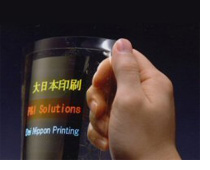
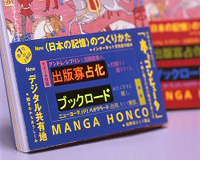 This is not fanciful speculation. Already DaiNippon Printing in Japan is experimenting with packaging that can 'speak' to the consumer via PLED (polymer light emiting diode) thin panels. Flexible, thin displays can be produced cheaply using inkjet printing methods pioneered by CDT (Cambridge Display Technologies), Seiko-Epson and Sumitomo.
(Pictured above: PLED packaging)
 In terms of manufacture, the polymers are extremely simple to produce, and the circuitry doesn't need to be any more complex than that already used in LCDs. Working with Seiko Epson, CDT has developed a thin film deposition technique that involves the application of drops of treacle-like polymer liquid as small as 30 microns across onto a patterned electrode array. Indeed, the technology has many potential advantages over LCD: only one sheet of plastic is required instead of two sheets of glass, PLEDs don't need backlights, so they consume less power, and since it's the surface of the PLED which emits light, wide viewing angles are possible.
 PLED displays are already in products such as a Philips shaver that tells you how much shaving time remains before next re-charge, and a Lexar 1Gb USB storage stick that indicated the amount of space remaining. Even a video TV watch (see picture right) using a PLED screen is now available from NHJ Electonics - and it even tells the time.
Electronic paper, or e-paper, e-ink has been in development for two decades but recent happenings indicate a 'tipping point' is fast approaching where – just like digital cameras and Apple's iPod – a new technology suddenly floods pell-mell into consumer consciousness, and older technologies begin to die off. From this month on (May) European firm iRex will be offering its iLiad 8.1” screen thin book reader for sale on its website.
According to a new report by the authoritative Dr Joe Webb of PrintForecast.com , “electronic paper is starting to appear on the market as a commercialized product. The e-paper market is highly dynamic, as new products enter the market almost daily.” Webb cites, in the past six months:
Quantum Paper's introduction of thin, flexible electronic displays that can be applied to paper and other substrates using conventional offset, flexo and gravure presses, enabling media-rich magazine inserts.
RFID-enabled e-paper tags that enable prices, offers etc. to be changed remotely rather than re-printing.
Sony's book reader is already on sale in Border's bookstores. Most leading publishers have embraced the idea of paid-for book downloads similar to Apple's iPod concept where already over 1 billion tunes have been downloaded and paid for.
In Europe, test marketing has begun on an e-newspaper reader.
My Call
It's all about creating and managing the content. Printing has only ever been a delivery system for information. A printer's primary skill is in content creation and management. Commodity print is a hiding to nowhere, so the name of the game for the next few years is to develop workflow and content management systems that enable you to integrate ubiquitous imaging into your business' offerings.
How many printers have embraced Macromedia Flash graphics now that Adobe owns it and offers it as an integral part of Creative Suite? Or is it a case of “oh, it moves so I'm not interested?”
It could take the 20 years mentioned by Sid Dalal, but there is no doubt in my mind that my kids will be reading 'magazines' that contain pages of dynamic information, moving pictures, spoken words and changing text, and buying packaged goods that provide a full animated description of the benefits - on the outside of the carton.
Think ubiquity.
 One significant paper is from Sid Dalal (pictured right), of Xerox's Imaging and Services Technology Center. Referring to 'Ubiquitous Imaging' where the image stores and becomes the medium for information dissemination, he said, “Pictures will someday speak more than a thousand words. Automation will be driven not by a system or device, but by the image itself.”
 This is not fanciful speculation. Already DaiNippon Printing in Japan is experimenting with packaging that can 'speak' to the consumer via PLED (polymer light emiting diode) thin panels. Flexible, thin displays can be produced cheaply using inkjet printing methods pioneered by CDT (Cambridge Display Technologies), Seiko-Epson and Sumitomo.
  In terms of manufacture, the polymers are extremely simple to produce, and the circuitry doesn't need to be any more complex than that already used in LCDs. Working with Seiko Epson, CDT has developed a thin film deposition technique that involves the application of drops of treacle-like polymer liquid as small as 30 microns across onto a patterned electrode array. Indeed, the technology has many potential advantages over LCD: only one sheet of plastic is required instead of two sheets of glass, PLEDs don't need backlights, so they consume less power, and since it's the surface of the PLED which emits light, wide viewing angles are possible.
 PLED displays are already in products such as a Philips shaver that tells you how much shaving time remains before next re-charge, and a Lexar 1Gb USB storage stick that indicated the amount of space remaining. Even a video TV watch (see picture right) using a PLED screen is now available from NHJ Electonics - and it even tells the time.
According to a new report by the authoritative Dr Joe Webb of PrintForecast.com , “electronic paper is starting to appear on the market as a commercialized product. The e-paper market is highly dynamic, as new products enter the market almost daily.” Webb cites, in the past six months:
My Call
It's all about creating and managing the content. Printing has only ever been a delivery system for information. A printer's primary skill is in content creation and management. Commodity print is a hiding to nowhere, so the name of the game for the next few years is to develop workflow and content management systems that enable you to integrate ubiquitous imaging into your business' offerings.
How many printers have embraced Macromedia Flash graphics now that Adobe owns it and offers it as an integral part of Creative Suite? Or is it a case of “oh, it moves so I'm not interested?”
It could take the 20 years mentioned by Sid Dalal, but there is no doubt in my mind that my kids will be reading 'magazines' that contain pages of dynamic information, moving pictures, spoken words and changing text, and buying packaged goods that provide a full animated description of the benefits - on the outside of the carton.
Think ubiquity.