


Weaving the Semantic Web – Fuji Xerox explores knowledge and communication for the Digital Generation
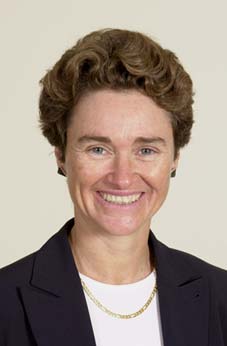 Fuji Xerox communications guru Anni Rowland-Campbell (pictured) reveals the thinking behind the latest government-sponsored research by Fuji Xerox Australia and RMIT.
In his best-selling book New Rules for the New Economy, Kevin Kelly explicitly discusses the way digital communications are changing the way we do business.
“Because communication – which in the end is what the digital technology and media are all about – is not just a sector of the economy, Communication is the economy.”
“Ever since Gutenberg made the first commodity – cheaply duplicated words – we have realised that intangible things can be copied. This lowers the value per copy. What becomes valuable is the relationships – sparked by the copies – that tangle up in the network itself. The relationships rocket upward in value as the parts increase in number even slightly.”
These relationships are about how people interact and communicate, how those that work well together can achieve something far greater than 'the sum of the parts', and how those that find it difficult to work together see communication as a major challenge.
The same is true for the communications technologies that now underpin our modern world.
Communication and the challenges it brings
Those of us who live and breathe the facilitation of communication on a daily basis, which includes the creation, management and dissemination of knowledge, are facing a challenge. When our systems – be they Microsoft, Apple PDF, JDF or XML – do not seamlessly talk to each other along the entire value chain, we face numerous revisions and reprinting, at the very least.
The C2C Project, undertaken under Print21, sought to more fully understand this communication and knowledge generation process from those who created – the authors, writers and academics – to those who consumed – the readers, students and general public. The three key research objectives were:
 Fuji Xerox communications guru Anni Rowland-Campbell (pictured) reveals the thinking behind the latest government-sponsored research by Fuji Xerox Australia and RMIT.
Following the completion of all the good work of C2C, a new research project is now being undertaken by Fuji Xerox Australia and RMIT, and funded with the financial assistance of the Commonwealth Government through an Australian Research Council Linkage grant.
Allowing digital communication to reach its full potential
This latest research will address: How exactly does the communication between creators and consumers work? What are the underlying standards and issues of inter-operability which need to be developed in order to move documents smoothly and seamlessly from the point of creation right through to consumption, in whatever medium the end-user required? Who controls the intellectual property along the way, and how does this impact on issues such as copyright and privacy?
Some of these questions are technical, but many are social and determine the way communications infrastructure and value chains will work in the future. These are the questions that now need to be answered if the promise of digital communications is to reach its full potential.
The major advantage of the project is that we are able to build on the work of the original C2C project. However, this time instead of focusing specifically on book publishing, we can focus on any type of document.
The research group combines a wealth of experience, expertise and knowledge. Dr Bill Martin will be looking at business processes aligned to digital workflow and value chains; Professor Mary Kalantzis at e-learning and education; Professor Margaret Jackson at intellectual property and law, and Dr Bill Cope adds strength with his understanding of the publishing industry.
Fuji Xerox jumps onboard
Fuji Xerox Australia will be contributing both its network of technology research and development, together with our practical understanding of the requirements of print rooms and document management, so that the outcomes of the project are both practical and offer the industry value that is immediately tangible. We will communicate the knowledge we gain back to the industry through industry workshops and written materials. Additionally, a reference group will be developed, such as existed within Print21 originally.
The importance of this research is not just in the knowledge that we gain, but also that we have secured Commonwealth Government funding for a project within our industry. Those of us who have long championed the promotion and development of our capabilities, and campaigned against the value that we add to the modern world being commoditised, should be very excited.
Anni Rowland-Campbell is a development manager with Fuji Xerox Australia. Prior to joining Fuji Xerox, she was executive director of GAMAA, and now works in the areas of organisational research and development. Anni is also undertaking a PhD through the Open University in the UK around the development of knowledge workers within the graphic technologies industries.
She can be contacted on: Anni