Why clean and green are two different things
"When it comes to printing, you would be surprised how many clients still ask for green when what they really want is clean," he said. Peck points to a classic example in Britain where a customer asked for brochures printed on 'green' paper. What he got back was green paper all right, literally. But it wasn't in any way recycled of environmentally friendly paper like that which the customer had in mind.
The recent fad known as 'green-washing' - that is, companies who promote themselves as being environmentally-responsible to gain the kudos of being good, ethical citizens really wouldn't know the forest from the trees when it came to helping save them.
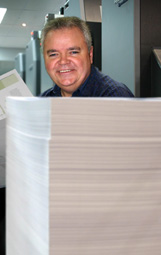
Peck (pictured) believes that this is something that runs rampant throughout the printing industry. "For a long time, 'green' has been associated with being recycled and in many cases now, it is neither," he said. "Clean, as opposed to the marketing term 'green' is what they [customers] should be asking for and, surprise surprise, there are lots of clean green paper products out there of an acceptable commercial quality."
Peck says that at Sprinta, the company uses a range of default stock lines that are 55 per cent pre-consumer waste and 45 per cent fibre-sourced from either ISO or FSC-certified plantations. They also prefer alternative paper production methods and look towards totally chlorine-free (TFC) or elemental chlorine-free (ECF) papers. "TCF and ECF papers are now every bit as good as any other commercially acceptable paper," he said.
Most of all, Peck believes that there is nothing green about traditional papers. "Brown might be a better word to use, for all the smoggy air pollution they produce," he said. "Clean is the best word to use; it's the word we use and the word our clients use."
For more information about eco-friendly printing see our up-coming 'Environment' issue of Print 21 published in early June.
Got a view on this story? Drop us a line and let us know


