Wide-format drives digital convergence at Photo Imaging World
A theme emphasised by graphic arts exhibitors at the expo was the idea that digital convergence is blurring the line between photolabs and quick printers, claiming that many photolabs are diversifying into wide-format production.
Steve Brown, graphic arts marketing at Canon Australia, was one such attendee who insisted that this trend would accelerate in the near future.
“Photolabs are taking over the retail space as the quick printers are moving out of it, and that's something I can see continuing to develop,” says Brown.
Kodak has a hefty footprint in both the photographic and graphic arts markets, and while its stand at Photo and Imaging World was devoted mostly to consumer products, wide-format had a sizeable presence.
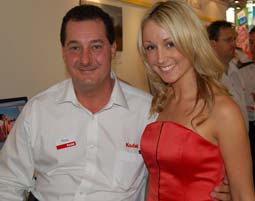 “For a photolab trying to diversify its operations, the machines allow it to perform a number of different types of jobs including point of sale and shop-front posters,” says Ross Gilberthorpe, marketing manager for Kodak GCG (pictured right with a Kodak glamour girl).
“This not only includes work for the general public but also full-scale production jobs. It's particularly relevant for regional areas that may not have quick printers, as it saves customers from needing to travel to the city.”
Craig Heckenberg, business unit manager at Epson, also sees an increasing demand for wide-format devices in the photolab market, precipitated by their ability to print at much wider widths and produce on a diverse range of media types like canvas.
Graphic arts production at Photo Imaging World
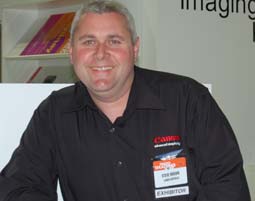 Canon used the event to launch its new range of ImagePROGRAF wide-format printers. The machines were unveiled recently at Ipex, but Photo and Imaging World represented the first time they were shown to the public in Australia.
Canon was showing off several new printers at the event, including the five-colour iPF500 that the company predicts will be picked up for general use by quick printers, and the 12-colour iPF5000 and iPF9000 machines that are targeted for colour critical high-end work.
Steve Brown (pictured above) says the introduction of a 12-colour ink system for the new machines makes an incredible difference to the image quality.
“This goes hand in hand with our bundled software, including our easy-to-use drivers and innovative Digital Photo Print Professional and PosterArtist software. This is what really separates us from everybody else,” says Brown.
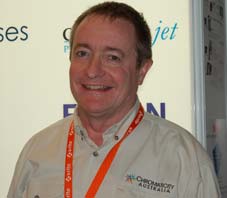 Imaging supplier DES took the opportunity to showcase the new Just Normlicht proofing lightboxes for which it recently secured distribution. Colour management expert David Crowther (pictured right) was on hand to provide his expertise, and claims the product has filled a gap in the company's lineup for both graphic arts operators and professional photographers.
“We met up with the company over at Ipex, and they were keen to team up with DES for local distribution,” says Crowther. “DES now offers a complete lineup for high-end proofing that's both price competitive and of an extremely high quality, including monitors, proofing devices and media.”
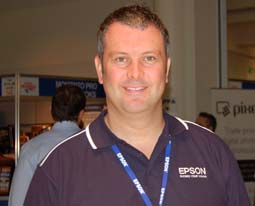 Epson was showing off its famed Stylus Pro range of wide-format printers, with Craig Heckenberg (pictured right) claiming the machines are the premium choice for photographic reproduction.
“The printers are ideal for photographers who want to bring the printing inhouse, and basically be offered control over the whole process,” he says.


 “For a photolab trying to diversify its operations, the machines allow it to perform a number of different types of jobs including point of sale and shop-front posters,” says Ross Gilberthorpe, marketing manager for Kodak GCG (pictured right with a Kodak glamour girl).
  Canon used the event to launch its new range of ImagePROGRAF wide-format printers. The machines were unveiled recently at Ipex, but Photo and Imaging World represented the first time they were shown to the public in Australia.
  Imaging supplier DES took the opportunity to showcase the new Just Normlicht proofing lightboxes for which it recently secured distribution. Colour management expert David Crowther (pictured right) was on hand to provide his expertise, and claims the product has filled a gap in the company's lineup for both graphic arts operators and professional photographers.
  Epson was showing off its famed Stylus Pro range of wide-format printers, with Craig Heckenberg (pictured right) claiming the machines are the premium choice for photographic reproduction.